 English
 русский
 Español
 عربى
عربى

Content
In the world of rubber and plastics processing, **Banbury mixers and kneaders** are like two strongmen with different personalities. While both can uniformly mix viscous raw materials, they differ significantly in their working methods and power.
We can examine their differences from the following perspectives:
1. Differences in Power and Force
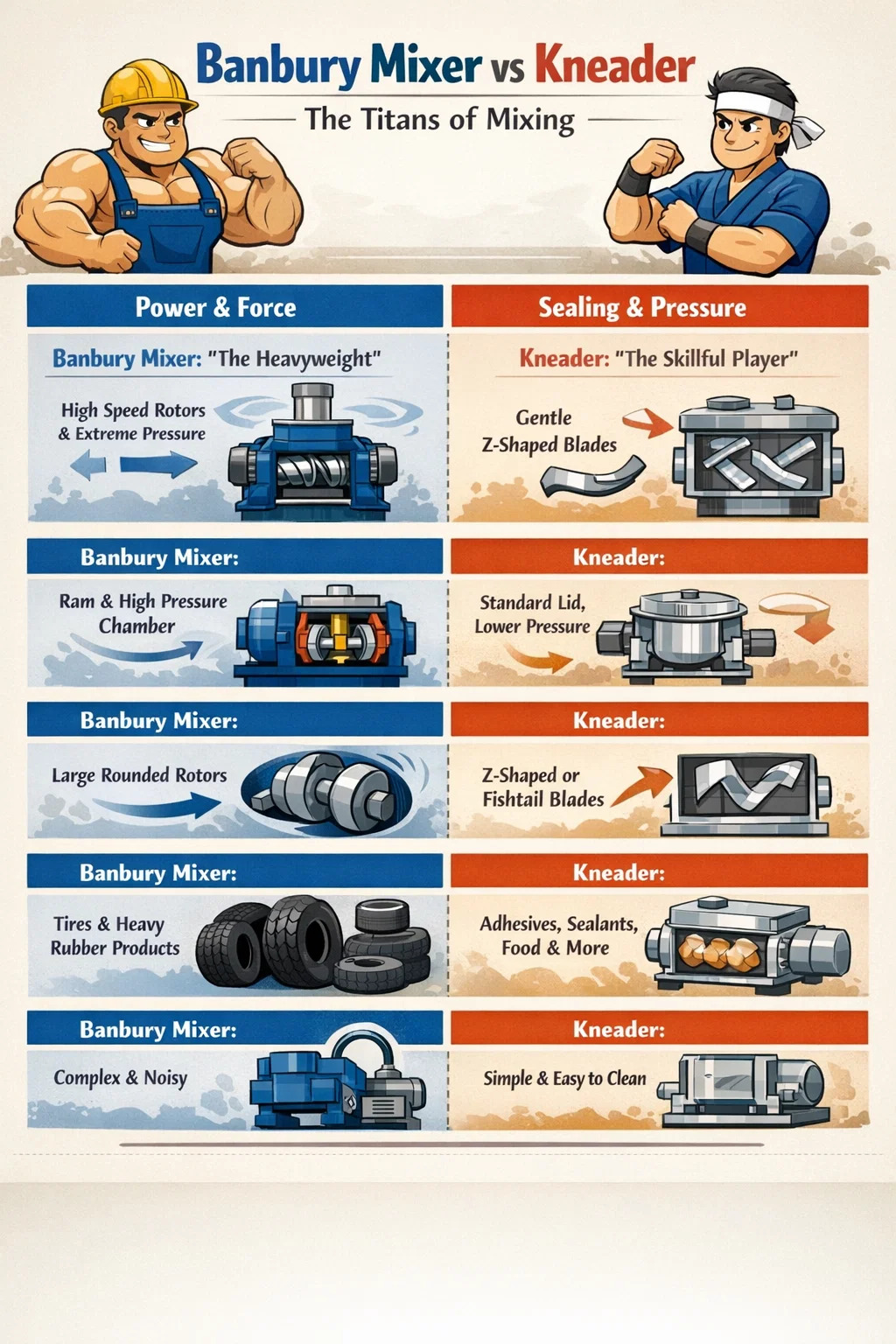
Banbury Mixer: It's a typical "heavyweight." Its structure is more robust, and the rotational force is incredibly powerful. It primarily relies on two massive rotors rotating at high speed in a sealed chamber, using extreme pressure and friction to thoroughly break down and mix hard rubber or plastic in a short time.
Kneader: It's more like a "skillful" player. While it also has power, its movements are relatively gentler and slower. It uses two Z-shaped or differently shaped blades to repeatedly fold and compress the material, similar to kneading dough. It emphasizes "slow and meticulous work," suitable for processing materials that are slightly more delicate, with high viscosity but not requiring extreme force.
2. Differences in Sealing and Pressure
Banbury Mixer: It has a distinctive component called a "ram" (commonly known as a pressure plug). During operation, this heavy ram forcefully presses the material downwards, causing the material to tumble in a completely sealed and high-pressure environment.
Kneader: Ordinary kneaders usually don't have that heavy ram. While some have lids and can even operate under vacuum, they mainly rely on the rotation of the blades to move the material, and the internal pressure is far less than that of a Banbury mixer.
3. Differences in "Chamber" Shape and Blades
Banbury Mixer: Its rotors are usually rounded and robust (like a large cashew nut), rotating at high speed and generating a lot of heat. Therefore, the mixing efficiency is extremely high, and a batch of material can be processed in just a few minutes.
Kneader: Its blades are usually thinner and longer, in a Z-shape or fishtail shape. This shape allows for better folding and turning of the material. Its trough is usually U-shaped or W-shaped, facilitating the movement of material between the two blades.
4. Strengths and Applications
Banbury Mixer's strengths: It's a favorite of tire manufacturers and large rubber parts factories. It specializes in handling large, hard, and high-volume black rubber materials that require rapid production.
Kneader's strengths: It's more versatile. Besides rubber, it can process various adhesives, inks, sealants, and even chocolate and dough. If you have strict temperature control requirements for your materials, or if the materials are delicate and cannot be overheated, a kneader is usually a better choice.
5. Ease of Operation and Maintenance
Banbury Mixer: It has a complex structure and is massive in size, making installation and maintenance a major undertaking. It also generates a lot of noise during operation.
Kneader: It has a relatively simple and straightforward structure, is easy to clean, and is convenient for changing material types. It's ideal for flexible production of multiple varieties in small batches.