
 English
 русский
 Español
 عربى
عربى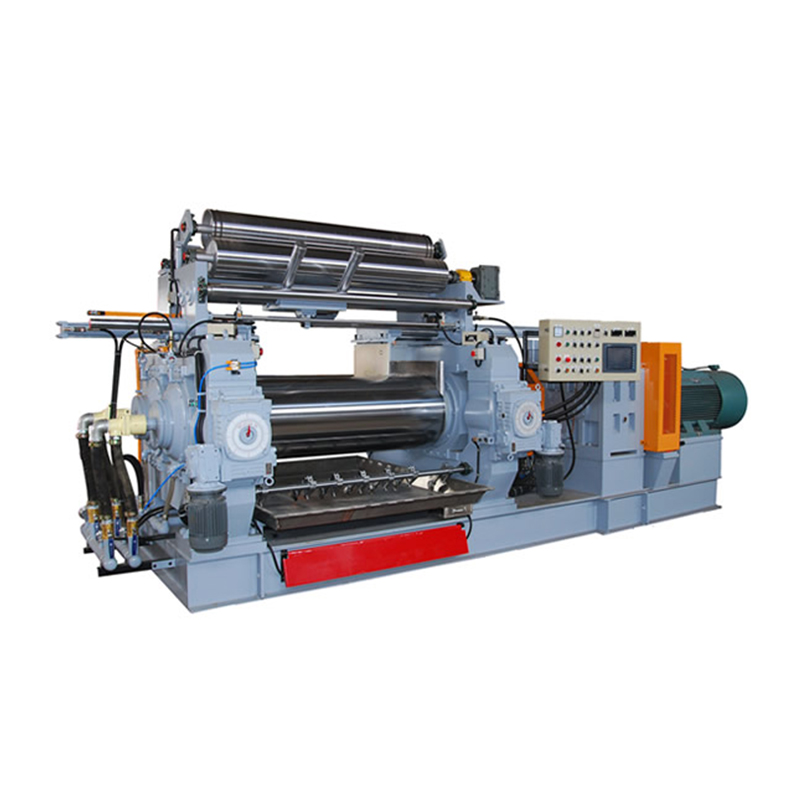
OTT RubberTech is a professional solution provider of rubber process formula, material, machinery with Mixer, Rubber Mixer, Mixing Mill, Precision Performer, Vulcanizing Press, Calender, batch-off Cooling unit, rubber Extruder, and other support plastic machines.
Features and Performance
Modern open mixing mills are designed with a heavy focus on safety, cooling efficiency, and precision gap adjustment. The rollers are usually made of chilled cast iron to provide a hard, wear-resistant surface that can maintain its shape under high nip pressures. Internal cooling systems are integrated into the rolls to prevent material scorching during prolonged milling sessions.
| Performance Feature | Detail and Specification |
|---|---|
| Roll Material | Chilled Cast Iron (HRC 68-75) |
| Nip Adjustment | Manual or Motorized Hydraulic Adjustment |
| Safety Systems | Emergency Knee Plates and Pull Cords |
| Friction Ratio | Customizable (Typically 1:1.1 to 1:1.25) |
| Bearing Type | High-Precision Roller or Nylon Bushings |
| Drive System | Direct Drive Gearbox for High Efficiency |
The ability to finely adjust the "nip" or the gap between the rollers allows operators to control the thickness of the rubber sheet and the intensity of the shearing action. High-performance mills feature perimeter-drilled rolls, which provide superior thermal conductivity compared to standard hollow rolls, ensuring that the rubber stays within its optimal processing temperature range. Safety is paramount, and these machines are equipped with rapid-stop braking systems that can halt the rollers in a fraction of a second.
Usage Tips and Techniques
Operating an open mill requires skill and experience to ensure both safety and material quality. The key to successful mixing is the "cutting and folding" technique, where the operator manually cuts the rubber sheet as it rotates and folds it back into the nip to ensure cross-directional blending. For consistent results, it is important to maintain a steady rolling bank of material in the nip area.
| Operation Phase | Optimization Technique |
|---|---|
| Mastication | Start with a tight nip to break down polymer chains |
| Additive Loading | Spread powders evenly across the width of the rolls |
| Refining | Pass the material through a very tight nip multiple times |
| Sheeting | Adjust nip to the final desired thickness for molding |
| Temperature Control | Adjust water flow based on the tackiness of the rubber |
When adding powders like sulfur or accelerators, it is best to do so once the rubber has formed a smooth, continuous "band" on the front roll. Using a scraper or an automatic blender can help reduce the physical labor involved and improve the uniformity of the mix. Operators should also be mindful of the "roll temperature" as different elastomers have specific thermal windows for optimal tack and flow; for instance, natural rubber requires more cooling than certain synthetic grades.
Maintenance Skills
The maintenance of an open mixing mill centers on roll surface integrity and bearing lubrication. Because the rolls are exposed, they are susceptible to damage from foreign metal objects, which can cause nicks or gouges. Regular inspection of the roll surfaces is necessary to ensure that they remain smooth and free of pitting. The lubrication of the main bearings is critical, as these components carry the full force of the mixing process.
| Maintenance Focus | Required Action | Frequency |
|---|---|---|
| Roll Surface | Visual inspection for scratches or gouges | Daily |
| Safety Brake | Test emergency stop functionality | Start of every shift |
| Lubrication | Check automatic grease pump operation | Daily |
| Nip Adjustment | Verify accuracy of gap measurement sensors | Weekly |
| Drive Gears | Inspect for wear and maintain oil levels | Monthly |
It is also important to maintain the cooling water rotary joints, as leaks in these areas can lead to water contaminating the rubber compound or damaging the bearings. Scaling inside the rolls should be treated with acidic cleaners periodically to ensure that heat transfer is not compromised. Finally, checking the tension and condition of the drive belts or couplings ensures that the mill operates at maximum energy efficiency and prevents sudden mechanical failure.
Application Scenarios
Two-roll mills are used in virtually every sector of the rubber industry, from laboratory research to large-scale manufacturing plants. Their ability to handle small batches makes them ideal for color matching and the development of new formulations. In production environments, they serve as the final stage for adding curing agents to compounds that have been mixed in an internal kneader.
| Usage Environment | Typical Function |
|---|---|
| R&D Laboratory | Small-scale compounding and testing |
| General Rubber Factory | Warming up stock for extruders |
| Silicone Processing | Mixing pigments into translucent silicone |
| Recycling Plants | Incorporating crumb rubber into virgin stock |
| Custom Compounding | Small-batch production for specialized orders |
In the footwear industry, open mills are frequently used to create marbled or multi-colored rubber sheets for shoe soles. In the technical rubber sector, they are utilized to refine high-value materials like FKM or silicone, where cleanliness and precise additive control are essential. Furthermore, the mill is a standard tool for creating test samples for rheometer and tensile strength analysis, ensuring that every production batch meets the required quality standards.

