 English
 русский
 Español
 عربى
عربى

Content
- 1 What a Rubber Kneader Machine Actually Does in Cable Compound Production
- 2 Core Cable Compound Types Processed with a Rubber Kneader
- 3 How the Rubber Kneader Machine Handles High-Filler Cable Formulations
- 4 Temperature Control in Rubber Kneader Operations for Cable Compounds
- 5 Rotor Geometry Selection for Cable Compound Mixing
- 6 Mixing Cycle Design and Process Parameters for Cable Compounds
- 7 Quality Control Parameters Measured After Rubber Kneader Processing
- 8 Rubber Kneader Machine Capacity and Scale Selection for Cable Plants
- 9 Automation and Process Control in Modern Rubber Kneader Systems
- 10 Common Processing Problems in Cable Compound Kneader Mixing and How to Solve Them
- 11 Energy Efficiency and Environmental Considerations in Rubber Kneader Operations
- 12 Maintenance Requirements for Rubber Kneader Machines in Cable Compound Service
- 13 Comparing the Rubber Kneader with Alternative Mixing Technologies for Cable Compounds
- 14 Trends Shaping Rubber Kneader Use in Cable Compound Processing
What a Rubber Kneader Machine Actually Does in Cable Compound Production
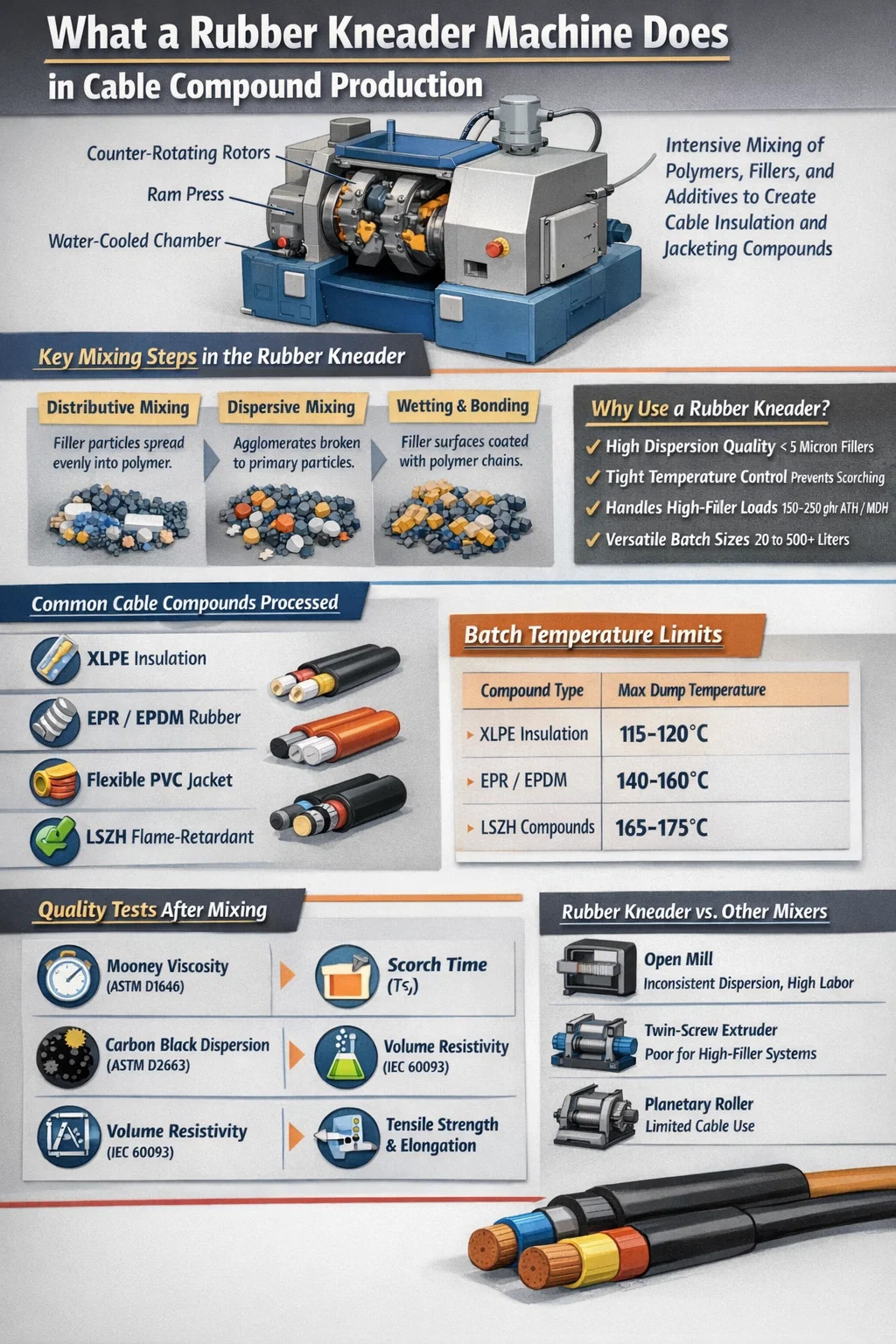
A rubber kneader machine—also called an internal mixer or dispersion kneader—is the core mixing equipment used to transform raw rubber or polymer base materials into finished cable compounds ready for extrusion. In cable manufacturing, the compound must meet strict electrical, mechanical, and thermal requirements. The rubber kneader achieves this by applying intense shear stress, compression, and heat to blend elastomers, fillers, plasticizers, antioxidants, flame retardants, and vulcanizing agents into a uniform, processable mass.
The direct answer: a rubber kneader machine is indispensable in cable compound processing because no other batch mixing technology delivers the same combination of dispersion quality, thermal control, and throughput capacity for high-viscosity elastomeric systems. Open mill mixing cannot match the enclosed, controlled mixing environment. Twin-screw continuous mixers lack the flexibility for short-run, multi-recipe production typical of cable compound facilities.
Cable insulation and jacketing compounds typically contain 15 to 30 individual ingredients. Getting each ingredient—especially carbon black, silica, and flame retardant fillers—dispersed to a primary particle level below 5 microns directly determines whether the finished cable passes dielectric strength testing, aging tests, and flame propagation standards such as IEC 60332 or UL 1666. The rubber kneader's rotor geometry creates the mechanical energy needed to break agglomerates and wet filler surfaces with polymer chains, a task that simpler mixing approaches simply cannot accomplish consistently.
Core Cable Compound Types Processed with a Rubber Kneader
Cable manufacturers work with a wide range of elastomeric and thermoplastic-elastomer compound families. Each places different demands on mixing equipment, and the rubber kneader handles all of them routinely.
XLPE and PE-Based Insulation Compounds
Cross-linkable polyethylene (XLPE) compounds for medium- and high-voltage power cables require extremely clean mixing environments and precise temperature management. Peroxide cross-linking agents begin decomposing above 120°C, so the rubber kneader must maintain batch temperatures below this threshold during incorporation. Modern water-cooled kneader systems achieve rotor surface temperatures stable within ±3°C, preventing premature scorch while still achieving thorough filler dispersion in batches ranging from 50 to 500 liters.
EPR and EPDM Insulation Compounds
Ethylene-propylene rubber (EPR) and ethylene-propylene-diene monomer (EPDM) compounds are widely used for medium-voltage cables (1 kV to 35 kV) and mining cables because of their excellent electrical properties and ozone resistance. These compounds typically contain 60 to 100 parts per hundred rubber (phr) of calcined clay or treated silica, demanding high rotor tip speeds—often 40 to 60 rpm—and extended mixing cycles of 8 to 14 minutes per batch. A rubber kneader with a fill factor of 0.65 to 0.75 optimizes shear work on these stiff, high-filler systems.
PVC Compound for Flexible Cable Jackets
Although PVC is a thermoplastic, flexible PVC cable jacket compounds containing 40 to 80 phr of plasticizer (typically DINP or DIDP) behave rheologically like rubber during mixing and benefit enormously from internal mixer processing. The rubber kneader gelates the PVC resin with plasticizer rapidly and uniformly, absorbing stabilizers, fillers, and pigments in a single pass. This produces a homogeneous compound with consistent Shore A hardness—typically 60 to 80—which is critical for cables that must pass cold-bend testing at −15°C or lower.
Silicone Rubber Compounds for High-Temperature Cables
Silicone rubber cables rated for continuous operation at 150°C to 200°C serve automotive, aerospace, and industrial heating applications. Polydimethylsiloxane gum compounded with fumed silica (typically 25 to 45 phr) and silane coupling agents demands the gentle yet thorough mixing action of a rubber kneader. Overmixing silicone breaks polymer chains and reduces compound viscosity irreversibly, so kneader machines used for silicone are programmed with strictly controlled cycle times and lower rotor speeds of 15 to 30 rpm.
Flame-Retardant (FR) and Low-Smoke Zero-Halogen (LSZH) Compounds
LSZH cable compounds—mandatory in railway, metro, shipbuilding, and public building installations under standards like EN 50399 and IEC 60332-3—contain 150 to 250 phr of mineral flame retardants such as aluminum trihydrate (ATH) or magnesium hydroxide (MDH). These ultra-high-filler loadings push the limits of any mixing equipment. The rubber kneader is effectively the only batch mixer capable of incorporating these filler levels into an EVA, EBA, or polyolefin elastomer matrix while maintaining acceptable compound rheology. Rotor designs with tangential or intermeshing geometry are selected specifically for this application, with cycle times of 10 to 18 minutes and batch temperatures carefully held below 170°C to prevent ATH dehydration.
How the Rubber Kneader Machine Handles High-Filler Cable Formulations
The single greatest technical challenge in cable compound processing is incorporating high volumes of solid filler—carbon black for semiconductive layers, ATH/MDH for flame retardancy, clay for EPR insulation—without creating poorly dispersed agglomerates or degrading the polymer matrix. The rubber kneader addresses this through three sequential mechanisms:
- Distributive mixing: The counter-rotating rotors divide and recombine the batch material repeatedly, spreading filler particles throughout the polymer volume. This happens primarily in the first 2 to 4 minutes of the mixing cycle when filler is still agglomerated.
- Dispersive mixing: As rotor speed increases or the ram pressure drops material into the rotor gap, shear stresses exceeding the cohesive strength of filler agglomerates break them apart. This is the critical phase for achieving dielectric-grade dispersion in insulation compounds.
- Wetting and surface chemistry: Continued mixing drives polymer chains onto freshly exposed filler surfaces, stabilizing dispersion and preventing re-agglomeration during subsequent processing. Coupling agents added during mixing chemically bond filler to polymer, improving the compound's mechanical and electrical performance permanently.
For a typical LSZH compound containing 200 phr MDH in an EBA matrix, the rubber kneader must deliver a specific mixing energy of 0.10 to 0.18 kWh/kg to achieve target dispersion. Modern kneader control systems track energy input in real time and use it as the primary endpoint criterion—far more reliable than time alone.
Temperature Control in Rubber Kneader Operations for Cable Compounds
Temperature is the parameter that most frequently causes cable compound failure. Too low, and fillers do not disperse; too high, and scorch, polymer degradation, or filler dehydration destroys the batch. The rubber kneader's temperature management system must handle both the heat generated by mechanical work and the heat that must be removed to protect sensitive ingredients.
| Compound Type | Maximum Dump Temperature (°C) | Primary Risk if Exceeded | Cooling System Required |
|---|---|---|---|
| XLPE (peroxide cure) | 115–120 | Premature peroxide decomposition (scorch) | Chilled water, rotor + chamber |
| EPR / EPDM insulation | 140–160 | Early vulcanization if sulfur present | Water-cooled rotors |
| LSZH (ATH-filled) | 165–175 | ATH dehydration, CO₂ release | High-capacity water cooling |
| Silicone rubber | 50–80 (gentle mix) | Chain scission, viscosity collapse | Controlled rotor speed |
| Flexible PVC jacket | 175–185 | Thermal degradation, HCl evolution | Jacketed chamber walls |
Modern rubber kneader machines achieve these tight temperature windows through multi-zone temperature control: the mixing chamber walls, the rotor shafts, and the ram are independently temperature-controlled using circulating water or oil. Infrared or contact thermocouples positioned at multiple points in the chamber give the PLC real-time data to adjust cooling flow rate or rotor speed automatically.
Rotor Geometry Selection for Cable Compound Mixing
The rotor is the heart of any rubber kneader machine, and the choice of rotor geometry profoundly affects compound quality in cable applications. Three primary rotor families are used:
Tangential Rotors (Non-Intermeshing)
Tangential rotors rotate in opposite directions without the rotor wings passing through each other's swept volumes. This configuration provides a larger free volume—fill factors up to 0.80—and handles very stiff, high-filler compounds without excessive torque peaks. For LSZH compounds with 200+ phr mineral filler, tangential rotors are generally preferred. The classic 2-wing and 4-wing tangential designs remain standard in cable plants worldwide, with 4-wing geometries offering faster incorporation of powdery fillers.
Intermeshing Rotors
Intermeshing rotors pass through each other's zone, creating a much tighter rotor gap and generating higher shear stresses. This makes them excellent for dispersive mixing tasks—breaking down carbon black agglomerates in semiconductive cable compounds, for example, where achieving a smooth, void-free surface on the extruded layer is essential for high-voltage cable performance. Intermeshing rotors also tend to run cooler because they exchange material between rotors more efficiently, improving heat transfer. However, they are less suitable for ultra-high-filler LSZH formulations due to torque limitations.
PES (Polyethylene Silicone) and Specialist Rotor Profiles
For silicone cable compound processing, specialized low-shear rotor profiles with larger clearances prevent destructive mechanical degradation of the silicone gum. Some manufacturers offer modular rotor systems allowing a single rubber kneader to be reconfigured between rotor types as the product mix changes—a significant operational advantage in cable plants producing multiple compound families on the same equipment.
Mixing Cycle Design and Process Parameters for Cable Compounds
The mixing cycle for a cable compound in a rubber kneader is not a simple "add everything and mix" operation. The sequence and timing of ingredient addition directly determines dispersion quality and scorch safety. A well-engineered cycle for a medium-voltage EPR insulation compound typically follows this structure:
- Stage 1 – Polymer mastication (0–2 min): EPR or EPDM bales are loaded and the ram is lowered. Rotors run at 30–40 rpm to soften and break down the polymer, reducing initial viscosity and preparing the matrix to accept fillers. Batch temperature typically reaches 80–100°C.
- Stage 2 – Filler incorporation (2–7 min): Calcined clay, silica, and carbon black (for semiconductive grades) are added incrementally or all at once depending on filler volume. Ram pressure is increased to 3–5 bar to force filler into the softened polymer. Rotor speed may increase to 50–60 rpm during this phase. Temperature rises to 120–140°C from friction.
- Stage 3 – Oil and plasticizer addition (7–9 min): Paraffinic or naphthenic oils and plasticizers are injected via liquid dosing systems. This lowers compound viscosity and distributes additives throughout the filler-polymer matrix.
- Stage 4 – Cooling sweep (9–11 min): Rotor speed is reduced, cooling water flow is maximized, and the batch temperature is brought below 110°C before curatives are added.
- Stage 5 – Curative addition and final homogenization (11–14 min): Sulfur or peroxide cure systems, accelerators, and antioxidants are added and blended in. Endpoint is determined by specific energy input reaching the target value, typically 0.12–0.16 kWh/kg for this compound type. The batch is then dumped to the discharge mill or conveyor below.
This staged approach prevents scorch, ensures even distribution of every ingredient, and produces a compound with a Mooney viscosity (ML 1+4 at 100°C) consistently within ±3 Mooney units of specification—a level of batch-to-batch consistency that open mill mixing cannot achieve.
Quality Control Parameters Measured After Rubber Kneader Processing
Every batch leaving the rubber kneader must be validated before it moves to extrusion. Cable compound quality control involves both rheological and electrical testing.
- Mooney Viscosity (ASTM D1646): Measures compound flow behavior. Out-of-spec viscosity causes extrusion dimensional instability. Typical specification window: ±5 Mooney units around the target value.
- Scorch Time (Ts2, ASTM D2084): Confirms that no premature vulcanization occurred during kneader mixing. For EPR compounds, Ts2 must typically exceed 8 minutes at 135°C to allow safe extrusion processing.
- Volume Resistivity (IEC 60093): For insulation compounds, volume resistivity must exceed 10¹³ Ω·cm at room temperature. For semiconductive compounds, it must be within the range 1–500 Ω·cm. Dispersion quality from the kneader is the dominant variable controlling this value.
- Carbon Black Dispersion (ASTM D2663): Optical microscopy or scanning electron microscopy of microtomed samples rates dispersion on a 1–5 scale. Grade 4 or better (fewer than 5% undispersed agglomerates above 10 μm) is typically required for medium-voltage cable insulation.
- Density and Filler Content: Confirms that filler was fully incorporated during kneader mixing. Significant density deviation from specification indicates incomplete mixing or ingredient loading error.
- Tensile Strength and Elongation at Break (IEC 60811-1): Measured on cured test plaques. Undersized tensile values indicate poor polymer-filler interaction resulting from inadequate kneader dispersion.
Rubber Kneader Machine Capacity and Scale Selection for Cable Plants
Rubber kneader machines for cable compound processing are available in a wide range of capacities, from laboratory units of 0.5 liters to production machines of 650 liters or more. Selecting the right machine size requires balancing batch size, cycle time, downstream extrusion line consumption rate, and inventory management strategy.
| Chamber Volume (L) | Net Batch Weight (kg, typical) | Motor Power (kW) | Typical Application |
|---|---|---|---|
| 0.5–5 | 0.3–3 | 0.75–7.5 | R&D, formula development, trial batches |
| 20–75 | 12–50 | 22–110 | Small cable plants, specialty compound production |
| 100–250 | 65–165 | 150–500 | Medium cable plants, multi-product facilities |
| 270–500 | 175–330 | 560–1,200 | Large-volume XLPE, LSZH, PVC production |
| 500–650+ | 330–430+ | 1,200–2,500 | High-volume power cable compound facilities |
A cable plant running two 90mm extruders for medium-voltage EPR cable at a combined output of 600 kg/hour will require approximately 10 batches per hour from a 75-liter kneader producing 60-kg batches per 6-minute cycle, or 3 batches per hour from a 200-liter kneader producing 130-kg batches per 10-minute cycle. The larger kneader usually wins on energy efficiency per kilogram mixed, but the smaller unit offers faster recipe changeover for plants with high product variety.
Automation and Process Control in Modern Rubber Kneader Systems
The rubber kneader machine of today is far removed from the manually controlled batch mixers of two decades ago. Fully automated kneader lines for cable compound production integrate several layers of control and data management that directly improve compound consistency and reduce waste.
Gravimetric Ingredient Dosing Systems
Automated weigh hoppers and liquid dosing pumps feed the rubber kneader with each ingredient to within ±0.1% of the target weight. This eliminates the largest source of batch-to-batch variation in manual mixing operations. For cable compounds where carbon black loading must be held to ±0.5 phr to maintain consistent volume resistivity in the semiconductive layer, this precision is not optional—it is essential.
Energy-Based Mixing Endpoint Control
Rather than running every batch for a fixed time, modern kneader control systems calculate cumulative specific energy (kWh/kg) in real time and dump the batch when the target energy is reached—regardless of whether that takes 10 minutes or 14 minutes on a given day. This approach compensates automatically for ambient temperature, raw material viscosity variations, and rotor wear, delivering more consistent dispersion than time-based control alone. Studies in industrial settings have shown that energy-endpoint control reduces Mooney viscosity spread by 30–50% compared to fixed-time mixing cycles.
Recipe Management and Traceability
Integrated SCADA or MES systems store hundreds of compound recipes and log all process parameters—temperature profiles, rotor speed, energy input, dump temperature, batch weight—for every batch produced. This batch traceability is mandatory for cable manufacturers supplying utility-grade power cables, where testing laboratories require complete process documentation alongside finished cable test reports.
Dust and Fume Extraction Integration
Carbon black, MDH, ATH, and silica dust present serious occupational health and explosion risks. Rubber kneader installations for cable compound processing integrate ram-top vacuum extraction, hopper-level dust collection, and chamber ventilation systems to keep workplace air quality within permissible exposure limits. This is an area where the enclosed nature of the kneader already provides an advantage over open mill mixing from a dust containment perspective.
Common Processing Problems in Cable Compound Kneader Mixing and How to Solve Them
Even with well-maintained equipment and automated controls, rubber kneader processing of cable compounds encounters recurring problems. Understanding the root causes allows process engineers to address them systematically.
Scorch During Mixing
Premature vulcanization inside the kneader is the most costly mixing defect—an entire batch of compound must be scrapped and the chamber cleaned, losing both material and production time. Scorch most often results from delayed curative addition (curatives added while compound is too hot), cooling system failure, or excessive rotor speed during the curative incorporation stage. Prevention: enforce strict temperature gate control (dump temperature of masterbatch below 100°C before curative addition), verify cooling water temperature and flow rate at shift start, and audit rubber kneader temperature sensor calibration quarterly.
Poor Carbon Black Dispersion in Semiconductive Compounds
Semiconductive cable layers must have smooth, well-dispersed carbon black to prevent electrical stress concentration at the conductor screen or insulation screen interface, which causes premature cable failure under high voltage. Poor dispersion in the kneader results from insufficient energy input, incorrect fill factor, or use of a carbon black grade with excessively high structure (high DBP absorption). Solutions include increasing specific energy input, verifying fill factor is within 0.65–0.75, and evaluating a lower-structure carbon black grade if dispersion remains inadequate.
Inconsistent Batch Viscosity
Batch-to-batch Mooney viscosity variation above ±5 units causes extrusion instability—dimensional variation in the cable insulation, shark-skin surface defects, or die pressure swings. Root causes include raw material viscosity variation (natural rubber and EPDM Mooney numbers vary between bale lots), incomplete oil absorption, or rotor wear increasing effective clearance over time. Address by tightening raw material incoming inspection limits, verifying oil dosing pump calibration, and scheduling rubber kneader rotor wear measurement every 3,000 operating hours.
Filler Agglomerates Surviving Mixing in LSZH Compounds
With 200 phr mineral filler, ATH or MDH particles can form cohesive agglomerates that resist dispersion, particularly if the filler has absorbed moisture. Pre-drying ATH or MDH at 80°C for 4–8 hours before kneader loading reduces agglomerate formation and can improve volume resistivity of the finished LSZH compound by one order of magnitude. Alternatively, increasing ram pressure during filler incorporation—from 3 bar to 5–6 bar—increases the compressive shear stress on agglomerates and accelerates dispersion.
Energy Efficiency and Environmental Considerations in Rubber Kneader Operations
Rubber kneader machines are energy-intensive equipment. A 250-liter kneader with a 500 kW main drive motor can consume 0.12–0.20 kWh of electrical energy per kilogram of compound produced, depending on compound viscosity and cycle time. For a cable compound facility producing 5,000 tonnes per year, this translates to 600,000 to 1,000,000 kWh annually—a significant electricity cost and carbon footprint.
Several strategies reduce kneader energy consumption without compromising compound quality:
- Variable-speed drive (VSD) motors: Replace fixed-speed main drives with VSD systems allowing rotor speed to follow the process curve precisely. VSD retrofits typically reduce kneader electrical consumption by 15–25%.
- Optimized fill factor: Running below 0.60 fill factor wastes energy because material slips around rotors without generating productive shear. Optimizing batch weight to the 0.70–0.75 range reduces energy per kilogram mixed by 10–15%.
- Heat recovery from cooling water: Cooling water leaving the kneader chamber at 40–60°C carries significant thermal energy that can be recovered via heat exchangers to pre-warm ingredient storage areas or provide space heating in winter months.
- Eliminating unnecessary masterbatch remilling: Some cable compound processes include a separate open mill re-milling step after the kneader. Engineering mixing cycles to eliminate this step—by achieving target dispersion in the kneader alone—removes both energy consumption and labor cost.
From an emissions standpoint, cable compounds containing halogen flame retardants release fumes during high-temperature mixing. LSZH compound processing does not present this issue, and the growth of LSZH cables in infrastructure projects worldwide is gradually reducing halogenated compound volumes processed through rubber kneader equipment globally.
Maintenance Requirements for Rubber Kneader Machines in Cable Compound Service
Cable compound processing is particularly demanding on rubber kneader mechanical components due to the abrasive nature of mineral fillers, the high fill pressures required, and the continuous operating schedules typical of cable manufacturing. A structured maintenance program is essential to prevent unplanned downtime.
- Rotor tip clearance measurement: Every 1,000–1,500 hours of operation, or whenever dispersion quality begins to decline, measure the clearance between rotor tips and chamber wall. Typical new clearance is 1–3 mm; clearance exceeding 6–8 mm indicates rotor wear requiring rebuilding or replacement. Worn rotors reduce shear intensity and degrade dispersion quality predictably.
- Ram seal inspection: Ram seals prevent compound from escaping the mixing chamber under ram pressure. Seal failure causes compound contamination of the hydraulic system and potential safety hazards. Inspect seals every 500 hours; replace on a time-based schedule every 2,000–3,000 hours regardless of apparent condition.
- Cooling circuit cleaning: Mineral scale and biological fouling in cooling water circuits reduce heat transfer efficiency, causing batch temperatures to drift upward. Flush and descale cooling circuits every 6 months, and treat cooling water with biocide and scale inhibitor continuously.
- Discharge door seal and locking mechanism: The drop door at the bottom of the mixing chamber must seal completely during mixing to maintain ram pressure and prevent compound leakage. Inspect locking pins and seals every 200 hours in high-filler LSZH service.
- Gearbox oil analysis: Send gearbox lubricating oil samples for laboratory analysis every 1,000 hours. Elevated iron or copper particle counts indicate bearing or gear wear and allow intervention before catastrophic gearbox failure—which can take a large kneader out of service for 4–8 weeks while parts are procured.
Cable compound plants typically budget 3–5% of rubber kneader purchase price annually for planned maintenance, with the majority of this cost attributable to rotor refurbishment (hard-facing wear surfaces with tungsten carbide or similar coatings) and seal replacement.
Comparing the Rubber Kneader with Alternative Mixing Technologies for Cable Compounds
Cable compound manufacturers occasionally evaluate alternatives to the rubber kneader machine. Understanding where alternatives succeed and where they fall short clarifies why the kneader remains dominant in this application.
| Technology | Strengths for Cable Compounds | Limitations | Best Fit |
|---|---|---|---|
| Rubber Kneader (Internal Mixer) | High dispersion quality, flexible batch size, tight temperature control, handles high-filler compounds | Batch process, requires downstream sheeting | Most cable compound types |
| Open Mill (Two-Roll Mill) | Low cost, easy cleanup, good for finishing/sheeting | Poor dust containment, inconsistent dispersion, labor-intensive, slow | Downstream sheeting after kneader only |
| Co-rotating Twin-Screw Extruder | Continuous output, compact footprint, good for thermoplastics | Limited dispersive mixing for high-filler systems, recipe changes require screw cleaning, poor for batch-cure systems | Thermoplastic cable compounds at high volume, single-recipe production |
| Planetary Roller Extruder | Continuous operation, gentle shear for heat-sensitive materials | Limited commercial adoption in cable, less capable for ultra-high filler loadings | PVC cable compound at some facilities |
The practical conclusion from this comparison: in cable compound manufacturing, the rubber kneader is combined with downstream open mill sheeting for 80–90% of production scenarios. The kneader provides superior dispersion; the open mill provides the sheet form required by extruder feeding systems. These are complementary technologies, not competing ones.
Trends Shaping Rubber Kneader Use in Cable Compound Processing
Several industry-level trends are influencing how cable manufacturers specify, operate, and optimize rubber kneader equipment today and in the near future.
Growth of LSZH Cable Demand
Building and construction regulations in Europe, the Middle East, and Asia-Pacific are progressively mandating LSZH cables in public infrastructure. The global LSZH cable market is expanding at rates of 7–10% annually in some regions. For rubber kneader manufacturers, this means growing demand for high-torque machines capable of processing 200+ phr mineral filler compounds—a technically demanding application that favors premium, purpose-engineered equipment over low-cost alternatives.
Electric Vehicle Cable Compounds
EV charging cables and high-voltage vehicle harness cables require compounds combining high flexibility (for repeated bending), heat resistance (125°C or higher), and chemical resistance to automotive fluids. Silicone rubber and cross-linked polyolefin compounds processed on rubber kneaders serve this market. As EV production scales globally, compound demand for these specialized cables is growing rapidly, pulling additional kneader capacity into service.
Digital Process Optimization and AI-Assisted Mixing
Some forward-looking cable compound facilities are implementing machine learning models that predict batch Mooney viscosity in real time from kneader torque and temperature data, allowing the control system to adjust rotor speed or extend the mixing cycle before dumping—rather than discovering out-of-specification viscosity during post-batch testing. Early adopters of these systems report first-pass yield improvements of 2–4 percentage points and reductions in compound scrap rate of 30–40%.
Sustainability Pressure on Compound Formulation
Growing pressure to eliminate restricted substances—certain plasticizers, lead-based stabilizers in PVC, halogenated flame retardants—is driving reformulation of cable compounds. New formulations often behave differently in the rubber kneader than the compounds they replace: higher melt viscosity, different filler-polymer interactions, longer mixing cycles. Cable compound developers must revalidate kneader mixing cycles whenever formulations change, adding to process engineering workload but also creating opportunities to optimize energy consumption and batch cycle time simultaneously.