
 English
 русский
 Español
 عربى


Content
- 1 Rubber Mixing Machine: The Equipment That Decides Batch Quality Before You Reach the Mold
- 2 Kneader or Open Mill: Which Rubber Mixing Machine Belongs in Each Process Stage?
- 3 Six Specifications That Decide Whether a Rubber Mixing Machine Will Work for You
- 4 Why Two Factories with the Same Rubber Mixer Get Different Results
- 5 Match the Rubber Mixing Machine to Your Product Line, Not Just to the Brochure
- 6 Maintenance and Safety: What Wears Out on a Rubber Mixing Machine
- 7 Frequently Asked Questions About Rubber Mixing Machines
- 7.1 What is the difference between a pressurized kneader and an open mixing mill?
- 7.2 How do I determine the batch size of a kneader?
- 7.3 What is the normal fill factor for a rubber mixing machine?
- 7.4 How do I prevent scorch during mixing?
- 7.5 Can I use one mixing machine for different rubbers such as silicone and EVA?
- 7.6 What upstream equipment improves the mixing process?
Rubber Mixing Machine: The Equipment That Decides Batch Quality Before You Reach the Mold
If you produce rubber seals, O-rings, footwear soles, hoses, or compounds for extrusion, a finished part rarely fails because of the press or the mold. It fails because the rubber mixing machine delivered an inconsistent compound. Falling tensile strength, drifting compression set, surface flow marks, and hidden porosity all trace back to the mixing room.
A rubber mixing machine performs three tasks in one cycle. It incorporates fillers, activators, and softeners into the polymer; it disperses them uniformly; and it plasticizes the mass into a processable material. The machine controls shear force, temperature, and mixing time, which together determine dispersion quality, scorch safety, and batch-to-batch consistency.
The practical production benchmark for a well-mixed compound is a Mooney viscosity spread of ±5 units between batches and a dispersion rating of 4 or above on the standard 10-point scale. If your mixer cannot hold these numbers, no downstream press, extruder, or curing system will compensate for it.
Kneader or Open Mill: Which Rubber Mixing Machine Belongs in Each Process Stage?
The first buying decision is about machine type. Most rubber product factories need both a pressurized kneader and a two-roll mixing mill, because they handle different stages of the same process rather than competing for the same job.
Pressurized Kneader: The Primary Mixing Machine
The pressurized kneader is the workhorse for masterbatch production. Rubber and ingredients are loaded into a closed chamber, and a pair of rotors kneads the material under pneumatic ram pressure. The enclosed design controls dust, stabilizes temperature, and creates the high shear needed to break down polymer chains and disperse carbon black or white fillers. Two-wing rotors are the common choice for general rubber goods; four-wing rotors change the shear profile and shorten cycle time for many compounds.
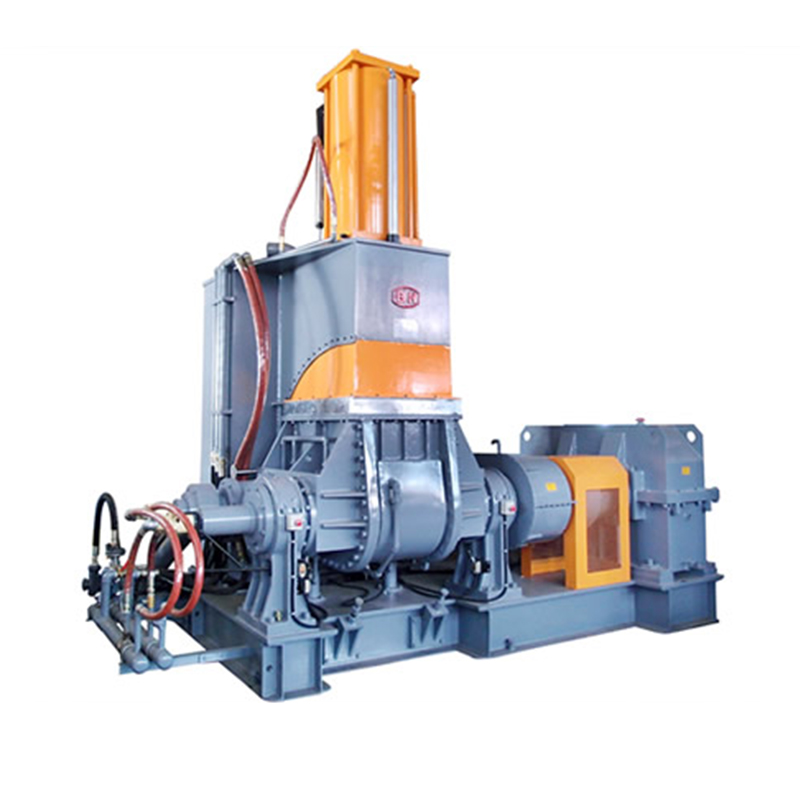 Pressurized Kneader for Masterbatch Rubber MixingThis enclosed machine provides the high shear needed to disperse fillers and break down polymer chains. It stabilizes temperature and controls dust, making it essential for producing consistent masterbatch before the two-roll mill.View Product →
Two-Roll Mixing Mill: Finishing and Curative Addition
The two-roll mixing mill handles the second stage. The compound is squeezed between two counter-rotating rolls and repeatedly cut, folded, and blended at a lower temperature. This is where sulfur and accelerators are added, because those ingredients must stay below their scorch threshold until the compound reaches the mold or extruder. The mill also produces a uniform sheet that feeds downstream equipment such as an extruder or a cold-feed preformer.
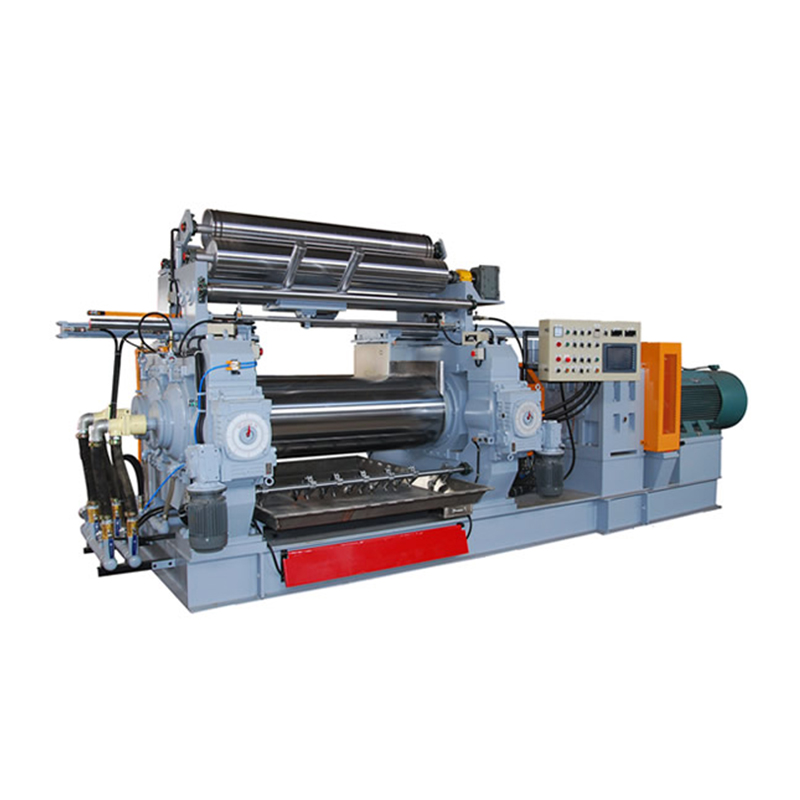 Two-Roll Mixing Mill for Final Compound SheetingAfter masterbatch, sulfur and accelerators are added on this mill under controlled conditions to prevent scorch. It produces a uniform sheet for downstream extruders and its specifications directly affect final quality.View Product →
| Feature | Pressurized Kneader | Two-Roll Mixing Mill |
|---|---|---|
| Mixing chamber | Enclosed and pressurized | Open rolls, atmospheric |
| Main process role | Masterbatch mixing | Curative addition and sheeting |
| Dust and fume control | Good | Moderate |
| Output form | Dump batch | Sheet or strip |
| Typical size | 10–110 L chamber | Roll diameter 16–26 inch |
| Nip hazard | Low | High; requires brake and guards |
Six Specifications That Decide Whether a Rubber Mixing Machine Will Work for You
Two machines can look identical in a brochure and still perform differently on your factory floor. Compare these six specifications in detail before signing the order.
| Specification | What It Affects | Practical Range |
|---|---|---|
| Chamber volume | Batch size and throughput | 10–55 L for most factories |
| Fill factor | Dispersion, temperature rise, cycle time | 0.70–0.85 |
| Rotor speed | Shear rate and mixing efficiency | 30–60 rpm |
| Motor power | Torque for high-filler or stiff compounds | 40–90 kW per 55 L chamber |
| Ram pressure | Filler incorporation and compaction | 0.4–0.8 MPa |
| Cooling system | Scorch safety and cycle time | Water-cooled jacket plus core cooling |
Discuss your actual compound with the supplier. If you process high-viscosity compounds such as NBR above 60 Shore A, or use heavy carbon black loading, choose a motor at the upper end of the power range and verify that the cooling channels are sized for continuous shift work.
Why Two Factories with the Same Rubber Mixer Get Different Results
Two plants can run the same model of mixing machine and still produce different compound quality. The difference comes from process discipline: fill factor, discharge temperature, mixing sequence, and weighing accuracy. These four factors account for most mixing defects seen in normal production.
| Problem | Typical Cause | Practical Fix |
|---|---|---|
| Scorching (pre-cure) | Discharge temperature too high or cycle too long | Reduce rotor speed; lower cooling water temperature; shorten cycle |
| Poor dispersion | Low fill factor, low ram pressure, short mixing time | Increase batch weight; raise ram pressure; extend mixing time |
| Sticking to rotors | High temperature, low fill factor, certain polymer grades | Drop batch temperature; adjust fill factor to 0.75–0.80; add release agent |
| Batch-to-batch variation | Manual weighing error, temperature drift | Use automatic small-chemical batching; calibrate temperature sensors |
Weighing accuracy is the foundation. An error of 1 to 2 grams in a curing agent can change the vulcanization rate enough to turn an entire batch into scrap. Factories that still rely on manual scale weighing can eliminate this risk with an automated weighing and feeding line; the mixer upstream equipment article on this site explains the typical layout.
Match the Rubber Mixing Machine to Your Product Line, Not Just to the Brochure
The right mixing package depends on the products you make. Here is how mixing equipment is typically selected for four common rubber product categories.
EVA and Rubber Soles
Shoe sole factories run a kneader to prepare masterbatch at a tightly controlled temperature, then use an open mill to sheet off material for molding. EVA compounds demand a narrow temperature window because cross-linking and foaming reactions are sensitive to thermal history. Temperature control matters more than rotor speed for this application.
O-Rings and Seals
O-ring and seal production requires fine filler dispersion because undispersed agglomerates become leak paths in the molded product. Use a kneader with a fill factor near 0.80, keep ram pressure at the higher end, and then feed the batch to a cold-feed precision preformer that maintains dimensional accuracy in every blank.
Hoses and Extruded Profiles
For extruded products, contamination control is the priority. A hot feed rubber strainer placed downstream of the kneader removes impurities and improves material purity before the compound enters the extruder screw.
High-Volume Production
Plants producing 10,000 or more parts per shift should pair the kneader with a batch-off cooling unit and an automatic feeding system. This prevents the mixer from waiting on manual handling and keeps a continuous flow of cooled, stacked compound ready for the next stage.
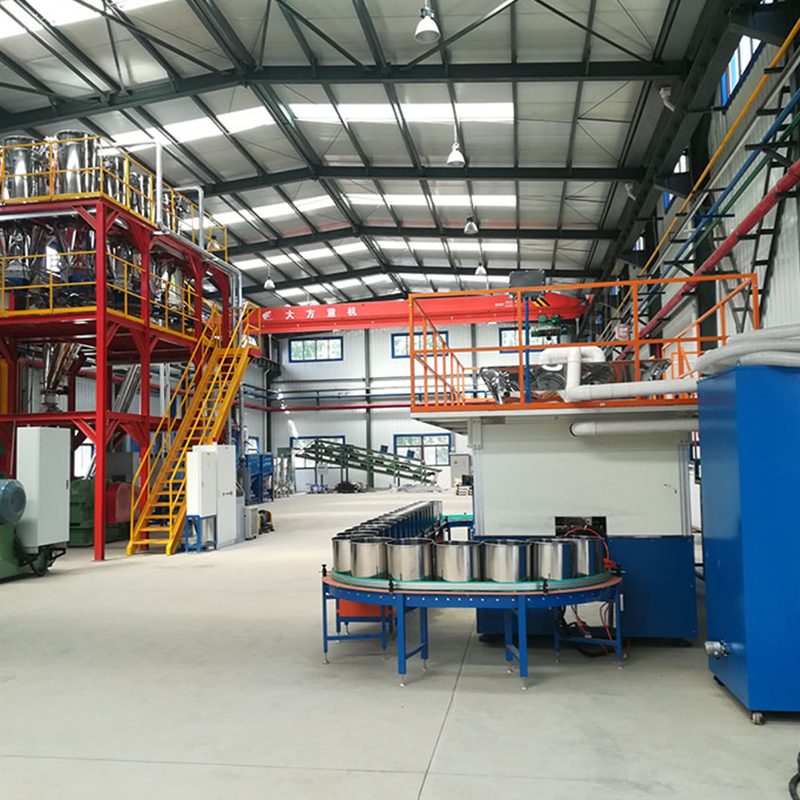 Upstream Equipment for Metering and Feeding MixersThis system automates the storage, weighing, and feeding of raw materials directly to the internal mixer. It ensures continuous, dust-controlled operation for high-volume production and reduces manual handling.View Product →
Maintenance and Safety: What Wears Out on a Rubber Mixing Machine
Rubber mixing equipment works with abrasive carbon black, fine zinc oxide, and high torque every shift. Wear is not a matter of if but when. A planned maintenance schedule keeps quality stable and extends machine life.
- Rotors and chamber wall: the clearance between the rotor tip and the chamber wall increases with wear. Check it with a feeler gauge every six months. Excess clearance produces poor dispersion and longer mixing cycles.
- Dust stops: these seals prevent powder from escaping along the rotor shafts. Replace them before visible leakage appears, because leaked ingredients change the compound ratio.
- Lubrication: use the oil grade specified by the machine builder for the gearbox and bearings. Substituting a different grade may save money on paper but will cost more in wear.
- Cooling system: scale deposits reduce heat transfer. If discharge temperature climbs over weeks, check the cooling channels for scaling before blaming the process settings.
- Safety devices: every open mill must have an emergency stop bar and a brake that stops the rolls within the specified time. Pressurized kneaders should have a hopper interlock and a hydraulic safety valve that releases pressure instantly.
Frequently Asked Questions About Rubber Mixing Machines
What is the difference between a pressurized kneader and an open mixing mill?
The pressurized kneader is an enclosed internal mixer that performs the main work of incorporating and dispersing fillers into the polymer. The open mixing mill is an exposed two-roll machine used for adding curatives at a lower temperature and for forming the compound into a sheet. They work as a pair in a typical compounding line.
How do I determine the batch size of a kneader?
Batch weight equals the chamber volume multiplied by the fill factor and the compound density. For a 55 L kneader with a 0.75 fill factor and a compound density of 1.15 g/cm³, the batch weight is about 47 kg. Check the density of your specific compound because high-filler materials weigh more per liter.
What is the normal fill factor for a rubber mixing machine?
Most kneader applications run at 0.70 to 0.85. Higher values improve throughput but raise temperature and torque. EVA and soft compounds can run near 0.80 to 0.85; stiff, high-hardness compounds may need to stay closer to 0.70 to avoid overloading the motor.
How do I prevent scorch during mixing?
Keep the discharge temperature below the scorch temperature of your compound, use a two-stage mixing process to add curatives on a cool mill, and verify that the cooling water channels are clean and the incoming water temperature stays below 30°C.
Can I use one mixing machine for different rubbers such as silicone and EVA?
Yes, but you must change rotor speed, temperature profile, and mixing time for each material. Silicone can cross-contaminate other compounds, so dedicate a machine for silicone or run thorough purge cycles with a cleaning compound between material changes.
What upstream equipment improves the mixing process?
Automatic small-chemical batching systems, carbon black weighing systems, and overhead feeding conveyors reduce manual error and shorten the loading time. These devices are collectively called mixer upstream equipment, and they are the most effective way to stabilize batch-to-batch consistency in a rubber mixing line.

