
 English
 русский
 Español
 عربى


Content
- 1 The Mixing Room Sets the Ceiling on Tire Quality
- 2 Straining, Cooling and Preforming: Small Steps With Expensive Failure Modes
- 3 Extrusion and Calendering: Shaping Components Before the Tire Is Built
- 4 Tire Building: Where Every Tolerance Stacks Up
- 5 Curing: Pressure, Temperature and the Bladder Behind Both
- 6 Inspection and Uniformity: The Last Chance to Catch a Defect
- 7 Common Process Faults and Where to Look First
- 8 Equipment Selection: What to Verify Before You Sign
- 9 FAQ: Tire Manufacturing Process Questions Buyers Ask Most
- 9.1 How long does it take to turn a batch of compound into a finished tire?
- 9.2 Which stage causes the most defects?
- 9.3 What temperature and pressure does tire curing actually use?
- 9.4 Why does green tire weight matter so much?
- 9.5 How accurate does a small chemicals batching system need to be?
- 9.6 Can one line produce both passenger and truck tires?
- 9.7 What is the most common mistake when buying rubber process equipment?
- 10 The Practical Takeaway
Tire manufacturing is a chain of seven linked operations, and the sequence matters more than any single machine: compound mixing, component preparation through extrusion and calendering, cutting and preforming, tire building, curing, and final inspection, with material handling and quality checks running alongside all of them. The short answer to where quality is won or lost is this: the mixing room decides what the tire is capable of, and the curing press decides whether the plant gets paid for it.
That is not marketing language. A single passenger tire carries roughly 200 raw materials and more than a dozen separate rubber compounds, based on the composition figures published by the U.S. Tire Manufacturers Association. Every compound has its own mixing sequence, temperature window and storage life. Every component has its own dimensional tolerance. Compound that leaves the mixer 5 degrees Celsius too hot will scorch in storage, long before it reaches a building drum. A green tire that leaves the building station 2 percent overweight can run short of cure time at the shoulder, and no amount of downstream inspection undoes that.
The ranges in this guide reflect common shop-floor practice in passenger, truck and off-the-road tire plants. Treat them as practical reference points rather than fixed rules, because the exact targets depend on the compound, the mold and the machine.
The Mixing Room Sets the Ceiling on Tire Quality
Mixing is a two-stage job in most plants. The masterbatch stage combines raw rubber, carbon black or silica, process oils, zinc oxide and protective agents in an internal mixer, usually with a chamber between 160 and 370 liters and a batch weight of 150 to 350 kg. The final mix stage adds the cure system at a much lower temperature, commonly dumped below 110 degrees Celsius, because accelerators and sulfur begin reacting above that threshold.
Two numbers decide whether a batch is good: the dump temperature and how evenly that temperature is spread through the chamber. Natural rubber rich compounds are typically dumped at 140 to 155 degrees Celsius. SBR and BR rich tread compounds run hotter, often 150 to 165 degrees Celsius, while silica compounds need a controlled hold in the 145 to 155 degrees Celsius band so the silane coupling reaction has time to complete. Cutting that hold short to save cycle time is paid back later as poorer dispersion and higher rolling resistance.
Weighing accuracy is the quieter risk. Bulk carbon black is normally dosed to within 0.5 percent of target, oils to within 0.2 percent, and small chemicals such as accelerators, sulfur and activators to within 1 gram or better. A 3 gram error in an accelerator looks trivial inside a 250 kg batch, but it shifts scorch time and cure curve in a way that surfaces as inconsistent hardness across a shift.
Weighing and feeding upstream of the mixer deserve their own review, from small chemical dosing to charge sequencing; this site explains the main functions of mixer upstream equipment in more detail. After the final mix, the compound is sheeted, cooled and left to mature, commonly 8 to 24 hours, so carbon black and curatives finish dispersing. Stacking compound above 40 degrees Celsius before cooling invites sticking, scorch and blocked strip.
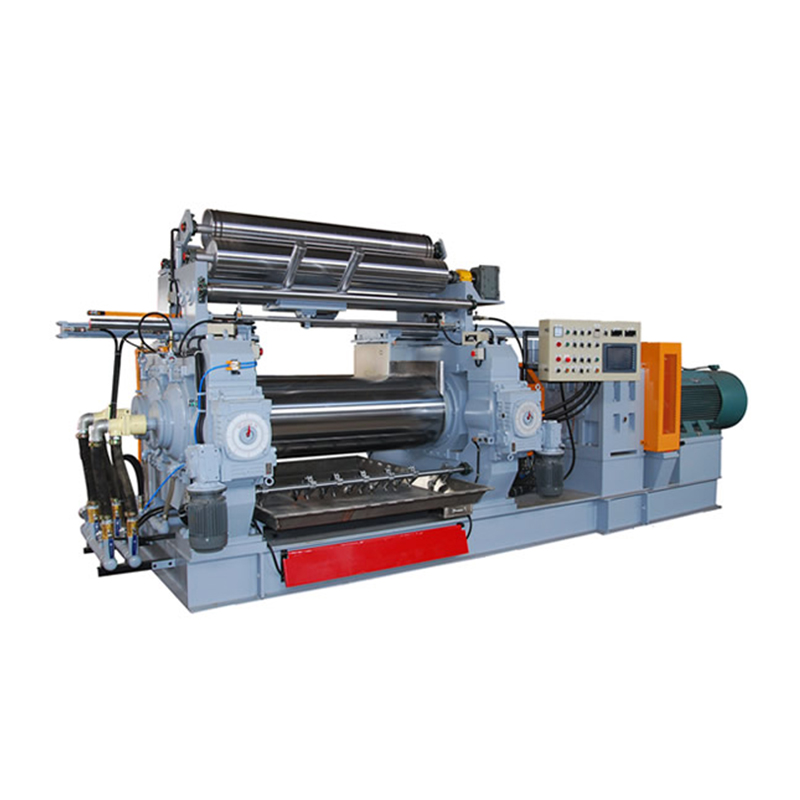 Mixing millThe rubber material is pulled into the roller gap at different linear speeds under friction between the two opposite rotating rollers. The barrel material is subjected...View Product →
An open mixing mill handles that sheeting step. Roll gap, roll temperature and the way strip is cut and turned on the roll determine whether the sheet enters the cooling line at a consistent thickness. A practical check at the mixer exit is a test sheet dispersion rating above 95 percent, combined with a cure meter reading that stays inside the same window batch after batch. When the cure curve drifts, the cause is usually in weighing or in the dump temperature log, not in the rubber supplier.
Straining, Cooling and Preforming: Small Steps With Expensive Failure Modes
Before the compound is shaped into anything, it normally passes a strainer. A hot feed strainer pushes warm compound through a 60 to 120 mesh screen at head temperatures of 70 to 90 degrees Celsius, catching cured lumps, tramp metal, fiber and bag residue. Straining is inexpensive compared with the alternative, which is a pierced inner liner or a belt separation that only appears on a shearography image after curing.
 Hot feed rubber strainerHot feed rubber strainer/Hot feed extruder set mixing, filtration, film in one, saving labor, efficient. Suitable for rubber, plastic, all kinds of elastomer filtratio...View Product →
Cooling comes next and is often underestimated. Batch-off cooling lines dip the sheet in a water bath and then hang it to drain and cool, with a target below 40 degrees Celsius before stacking. Cooling is more than logistics: it stops the cure system from starting early and keeps the compound from welding into unusable slabs.
The last step in material preparation is preforming, which means cutting a weighed blank from the compound strip. Cold feed precision preformers cut volumetric or weight controlled blanks, usually holding blank weight within 1.5 to 2 percent. That tolerance matters because blank weight drives cure behavior later, and a blank that runs short leaves the mold cavity starved while the press still burns a full cycle.
Between straining, cooling and preforming, a plant usually loses more output to handling than to machine speed. Sticky compound, manual stacking and inconsistent strip width all slow the line quietly, and the fix is usually a combination of temperature control and a conveyor layout that stops operators from touching hot compound.
Extrusion and Calendering: Shaping Components Before the Tire Is Built
Tread and sidewall profiles are extruded. A typical tread line runs a screw of 90 to 150 mm, with barrel temperatures of 50 to 80 degrees Celsius and head temperatures of 80 to 100 degrees Celsius. The profile leaves the die swollen and then shrinks as it cools, so die design has to compensate for roughly 10 to 25 percent die swell and 5 to 15 percent shrinkage, depending on compound and take-off speed.
A well-run line holds finished tread thickness within about 0.5 mm and width within about 2 mm. Tread thickness outside that band changes the shoulder profile and moves the heat path during curing, which shows up as cured gauge variation and extra material cost at the same time.
Body ply, belt and inner liner compounds go through calendering instead. A four roll calender coats rubber onto textile or steel cord fabric at 0.4 to 1.2 mm thickness, usually held within 0.02 to 0.05 mm across the full width, with cord spacing controlled within 0.5 mm. If coating runs thin on one edge, the cord is partly exposed and the tire becomes more likely to fail at that shoulder. This is why gauge is checked edge to edge and not only in the middle of the roll.
Cutting equipment sits between extrusion, calendering and building. Sheet, strip and ply are all cut to length at angles that follow the finished tire geometry. Blade alignment and cut angle accuracy of a fraction of a degree matter more than most buyers expect, because a skewed ply cut costs material on every single tire and shows up as splice variation in the finished product.
Tire Building: Where Every Tolerance Stacks Up
Building is the assembly step: beads, inner liner, body plies, belts, sidewalls and tread are placed on a drum by a tire building machine. A passenger tire cycle runs about one to three minutes, while truck tires take longer and often need a two stage machine with a separate belt and tread drum.
Three measurements tell you how a building line is performing: green tire weight, component runout and splice placement. Most plants hold green tire weight within 1 percent of target, runout within roughly 1 mm, and ply or belt splices to a defined gap. Green tire weight is the best early warning signal available. An overweight green tire wastes expensive compound and stretches the cure cycle, while an underweight one usually means a component is short or missing somewhere in the stack.
Tack is the other variable that never appears on a datasheet but decides daily output. Compound that is too cool or too old does not stick, splices open inside the press, and operators compensate with hand pressure that cannot be repeated from shift to shift. Controlling building area temperature at 20 to 30 degrees Celsius, and using preformed blanks within a few hours of cutting, does more for splice quality than any single machine adjustment.
Curing: Pressure, Temperature and the Bladder Behind Both
Curing turns the green tire into a finished one. The green tire is loaded into a curing press, a bladder is inflated inside it, and heat is transferred from the mold outside and from the bladder medium inside. Mold temperatures sit between 150 and 180 degrees Celsius. The internal medium is normally saturated steam or nitrogen at 1.6 to 2.2 MPa, and that internal pressure is what presses the tread and sidewall against the engraved mold. Pressure loss during the cure shows up as light tread, porosity or an incomplete pattern.
Cure time scales with size and compound: roughly 8 to 15 minutes for a passenger tire, 40 to 70 minutes for a truck tire, and several hours for large off-the-road sizes. The bladder is a consumable rather than a spare part. Common shop-floor life for passenger tire bladders sits in the 400 to 600 cure cycle range, and it drops when a press runs short cycles at high temperature. Failure modes worth tracking include shoulder thinning, pin holes from trapped air and hardening from over-temperature steam.
 Horizontal tire airbag machineThe working principle of the tire bladder injection thermoforming machine mainly involves the thermoforming process of rubber, which is crucial to the production of ti...View Product →
Bladders are themselves molded rubber products, produced on dedicated equipment such as a horizontal tire airbag machine, where shape accuracy and wall thickness consistency decide how many cure cycles the finished bladder will survive. Buying bladders on price alone usually raises cost per cure, because a bladder that fails early stops a press and forces a manual mold clean.
After curing, many plants add post cure inflation, holding the tire inflated while it cools to limit growth and improve uniformity. Skipping it is a common shortcut in plants under cost pressure, and it reappears as higher conicity and more balance correction weights in the inspection area.
Inspection and Uniformity: The Last Chance to Catch a Defect
Final inspection is usually a combination of methods: visual check, X-ray for belt and bead placement, shearography for separations and bubbles, and a uniformity machine measuring radial and lateral force variation, conicity and runout. Passenger tire plants commonly cap radial force variation in the 70 to 100 newton range depending on customer requirements. Tighter limits cost yield, looser limits cost warranty claims, and the right line sits where the plant can actually hold it.
Cost escalation is what makes inspection logic matter. A compound problem caught at the mixer costs one batch. The same defect found after building costs the components plus the labor. Found after curing, it costs the entire tire plus press time that could have produced a sellable unit. Found by a customer, it costs the tire plus a claim plus the freight. This is why serious plants keep spending on mixing control and green tire weight checks even when the press department is asking for the budget.
| Stage | Core equipment | Key control parameter | Typical range |
|---|---|---|---|
| Compound mixing | Internal mixer, open mixing mill | Dump temperature, batch weight accuracy | 140 to 165 C; bulk within 0.5 percent |
| Straining and cooling | Hot feed strainer, batch-off line | Screen mesh, strip temperature | 60 to 120 mesh; below 40 C before stacking |
| Preforming | Cold feed precision preformer | Blank weight tolerance | 1.5 to 2 percent of target |
| Extrusion | Screw extruder, tread line | Die swell, profile thickness | 10 to 25 percent swell; within 0.5 mm |
| Calendering | Four roll calender | Coated thickness, cord spacing | 0.4 to 1.2 mm within 0.05 mm |
| Tire building | Building drum or TBM | Green tire weight, runout | Weight within 1 percent; runout within 1 mm |
| Curing | Curing press with bladder | Mold temperature, internal pressure | 150 to 180 C; 1.6 to 2.2 MPa |
| Inspection | X-ray, shearography, uniformity machine | Radial force variation, conicity | Roughly 70 to 100 N RFV cap |
Common Process Faults and Where to Look First
Most tire defects trace back to one of four stages: mixing, extrusion, building or curing. When a problem appears, the fastest route to a fix is to match the symptom to the stage that owns it, then check the simplest physical cause before touching recipes.
| Symptom | Likely stage | Check first |
|---|---|---|
| Scorch or dead compound | Mixing | Dump temperature log, time before curatives are added, storage temperature |
| Blisters or porosity | Curing and building | Trapped air in the green tire, bladder pressure curve, moisture in compound |
| Under-cure at the shoulder | Curing | Internal pressure drop, mold temperature drift, overweight green tire |
| Belt misalignment | Building | Drum alignment, ply tension, splice position |
| High radial force variation | Building and curing | Component runout, tread splice, asymmetric bladder inflation |
| Rough tread surface or die lines | Extrusion | Die temperature, contamination on the die, screw speed stability |
| Open splice or seam | Building | Compound age and temperature, splicing pressure, surface contamination |
Equipment Selection: What to Verify Before You Sign
Whether a plant produces tires, retreads, air springs or technical rubber parts, the same purchase questions decide the outcome: repeatability, controllability, and service after installation.
- Repeatability: ask for cycle-to-cycle variation, not just nameplate capacity. A mixer that holds dump temperature within 2 degrees Celsius is worth more than a larger chamber that wanders.
- Weighing and dosing accuracy: request documented figures for bulk and small chemicals, and ask how the system reacts to a clogged feed or a bridging hopper.
- Temperature control: every stage, from mixer to extruder head to mold, needs sensors in the right location and a stated response time.
- Changeover and recipe management: how long does a compound or size change take, and how many recipes can be stored and locked against unauthorized edits?
- Consumables: bladder life, screen cost, knife wear and the lead time for each of them. Consumable cost per cure often exceeds the machine payment.
- Factory testing and documentation: confirm which tests run before shipment and what records travel with the machine.
- After-sales response: the fastest way to lose a season of output is equipment standing idle while a support ticket waits in a queue.
OTT RubberTech International Trading (Shanghai) Co., Ltd. sits in the middle of this supply chain. The company has worked in rubber machinery for more than 15 years and covers compounds and auxiliaries, single machines and complete production lines, from mixers, strainers, preformers and extruders through injection, curing and trimming equipment, plus full lines for soles, hoses, seals and tennis balls. It advertises a three day quotation response and states that each machine is tested before packing, two practical points when a replacement strainer or preformer is holding up a running line.
FAQ: Tire Manufacturing Process Questions Buyers Ask Most
How long does it take to turn a batch of compound into a finished tire?
Once a compound has matured, a green tire is built in roughly one to three minutes for a passenger size and cured in another 8 to 15 minutes, so a tire can move from preform to inspection inside 30 minutes. The real lead time comes from mixing and maturation, since plants normally hold compound 8 to 24 hours before use to let carbon black and curatives finish dispersing.
Which stage causes the most defects?
Mixing and curing account for the largest share of repeat defects in most plants. Mixing controls dispersion, scorch safety and cure curve consistency, while curing controls pressure and heat penetration. Building errors are usually visible earlier and are easier to correct, which is why they cost less in aggregate.
What temperature and pressure does tire curing actually use?
Mold temperatures typically sit between 150 and 180 degrees Celsius, with saturated steam or nitrogen inside the bladder at 1.6 to 2.2 MPa. Cure time ranges from about 8 minutes for a small passenger tire to more than an hour for truck and off-the-road sizes.
Why does green tire weight matter so much?
Green tire weight is the fastest indicator of whether every component was placed correctly. Plants usually hold it within 1 percent of target. An overweight tire wastes compound and can be under-cured at the thickest section, while an underweight tire usually points to a missing ply, a short tread or a light bead bundle.
How accurate does a small chemicals batching system need to be?
A practical target is 1 gram or better for accelerators, activators and sulfur, with bulk materials within 0.5 percent and oils within 0.2 percent. Small chemical errors change scorch time and cure rate, and the resulting variation usually appears as inconsistent hardness between batches rather than as an obvious reject.
Can one line produce both passenger and truck tires?
In practice, rarely. Press tonnage, bladder size, drum geometry, extruder output and curing time differ enough that most plants dedicate equipment to a size family. Trying to run both on one line usually costs changeover time and adds defects at the extremes of the size range.
What is the most common mistake when buying rubber process equipment?
Buying on capacity and price while ignoring repeatability and consumable cost. A machine that is 10 percent cheaper but drifts on temperature, weight or cycle time will consume the difference in scrap, rework and manual intervention within a single production year.
The Practical Takeaway
The tire manufacturing process is less a machine problem than a tolerance problem. Every stage passes its error to the next one and amplifies it: a 3 gram dosing error becomes a cure curve shift, a cure curve shift becomes hardness variation, and hardness variation becomes a rejected tire that consumed press time, labor and compound.
For plants planning new capacity or replacing aging equipment, the priority order is consistent. Control mixing first, because dispersion and dump temperature set the ceiling on everything that follows. Fix material preparation and preforming second, since blank weight and clean compound protect the building station and the mold. Get curing pressure and temperature under control third. Leave inspection for last, because inspection protects the customer, while the first three protect the plant.

