 English
 русский
 Español
 عربى
عربى

Content
- 1 What an Atta Kneader Is Actually Used For
- 2 The Specific Types of Dough an Atta Kneader Handles
- 3 How a Kneader Machine Works: The Mechanism Behind the Results
- 4 Atta Kneader vs. Hand Kneading: A Practical Comparison
- 5 Key Features That Distinguish a Good Atta Kneader
- 6 Step-by-Step: Using an Atta Kneader Correctly
- 7 Commercial vs. Home Atta Kneaders: Different Scale, Same Principle
- 8 Common Problems When Using an Atta Kneader and How to Fix Them
- 9 The Role of Atta Type in Kneader Performance
- 10 Maintenance and Care for an Atta Kneader
What an Atta Kneader Is Actually Used For
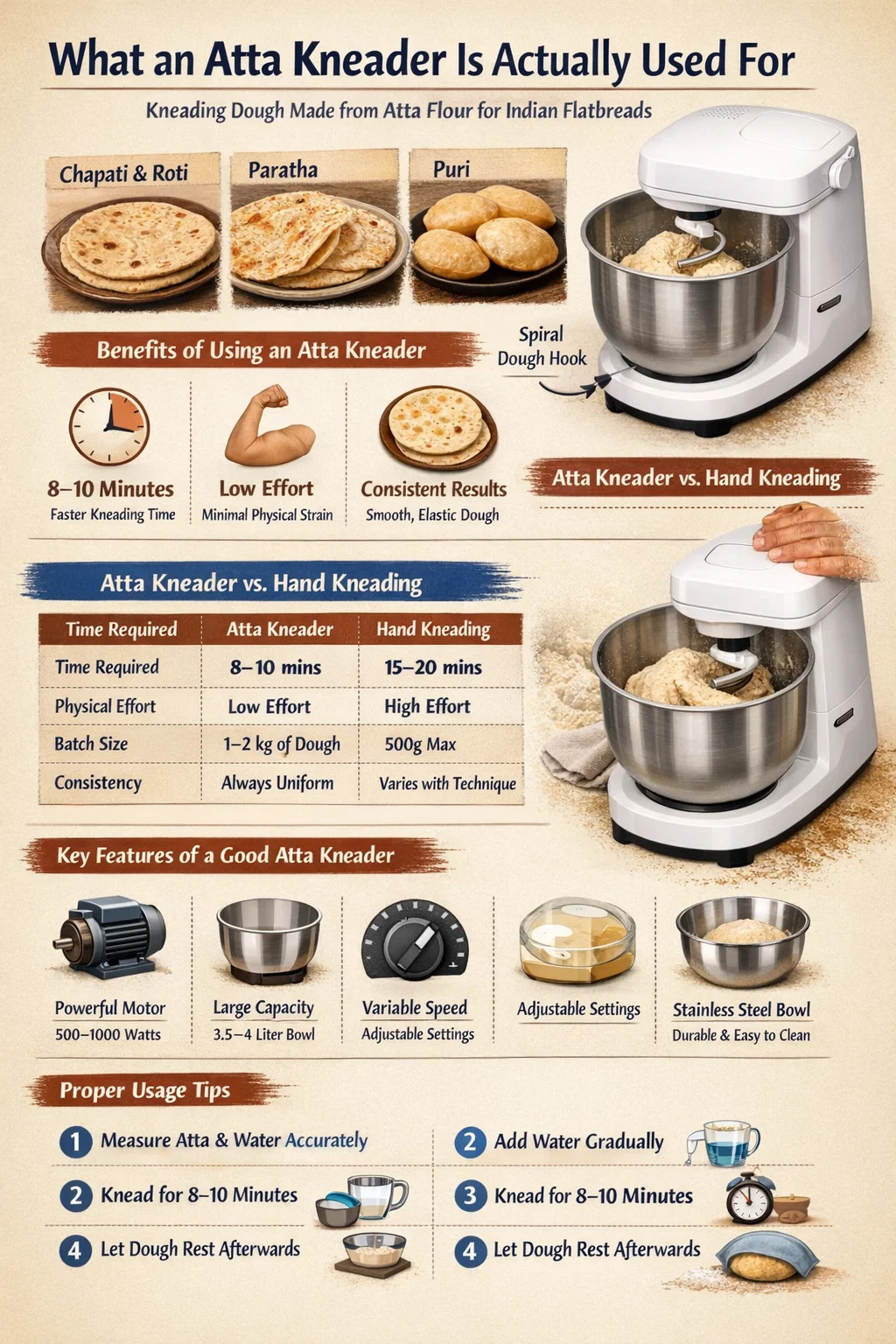
An atta kneader is a kitchen appliance or attachment specifically designed to mix and knead dough made from atta flour — the whole wheat flour used as the foundation of Indian flatbreads like chapati, roti, paratha, and puri. The machine replicates the folding, pressing, and stretching motions of hand kneading, developing gluten strands in the dough to create the soft, pliable texture needed for flatbreads that puff evenly and stay tender after cooking.
At its core, a kneader works by subjecting the dough to repeated mechanical stress in a controlled way. Unlike a standard food processor that simply cuts and blends, a kneader applies a rhythmic pressing and folding action. This activates the gluten proteins in atta — glutenin and gliadin — causing them to link together into an elastic network. A well-kneaded dough made with atta typically requires 8 to 10 minutes of machine kneading, compared to 15 to 20 minutes by hand.
The term "atta kneader" is used both for standalone countertop machines built specifically for this purpose and for dough kneading attachments that fit onto stand mixers. Both function on the same mechanical principle, though standalone units are often optimized for the viscosity and density of whole wheat atta dough specifically.
The Specific Types of Dough an Atta Kneader Handles
While the name references atta flour, a quality kneader machine is versatile enough to handle a wide range of dough types. Understanding what dough each application requires helps clarify why the kneading mechanism matters so much.
- Chapati and Roti Dough: Requires a soft, smooth consistency with moderate gluten development. Kneaders achieve this by running at medium speed for 6 to 8 minutes, incorporating water gradually to prevent the dough from becoming sticky.
- Paratha Dough: Slightly stiffer than roti dough because it needs to hold layers when folded with ghee or butter. A kneader develops the gluten just enough to create structure without making the dough tough.
- Puri Dough: Firmer and tighter, as puri needs to puff when deep fried. The kneader runs for a shorter cycle and less water is added, producing a stiffer dough ball.
- Pizza and Bread Dough: Many atta kneaders double as general dough kneaders. For yeast-leavened doughs, the kneader typically runs for 10 minutes, developing the strong gluten network needed for bread to rise and hold its structure.
- Cookie and Pastry Dough: Some kneaders with adjustable speed settings handle softer, fat-enriched doughs where over-kneading is a risk. The short, low-speed cycle prevents excessive gluten development that would toughen cookies.
The critical point is that atta — being a whole wheat flour with higher fiber content than refined flour — is denser and more resistant to hydration. A kneader built for atta is calibrated to handle this density without overheating the motor or straining the mechanism.
How a Kneader Machine Works: The Mechanism Behind the Results
Understanding the mechanism of a kneader helps explain why it produces better dough than mixing by hand or using a blender. The key is the motion of the kneading hook or arm.
The Dough Hook Action
Most atta kneaders use a spiral dough hook or a J-hook attachment. The hook rotates around a central axis while also moving in a planetary orbit — meaning it sweeps the entire bowl rather than staying in one spot. This dual motion ensures every part of the dough mass gets worked evenly. The dough is continuously pushed down, folded over itself, and pulled back up, mimicking the push-and-fold technique experienced cooks use by hand.
Gluten Development Through Mechanical Work
Gluten forms when water activates the proteins in wheat flour and mechanical action aligns them into long, parallel chains. Insufficient kneading leaves gluten strands short and disorganized, producing dough that tears during rolling and flatbreads that come out dense and chewy. A kneader applies consistent mechanical force across the entire dough mass simultaneously, which is something human hands physically cannot replicate at the same rate or uniformity.
Temperature Management
One detail often overlooked is that friction during kneading generates heat, and heat affects dough behavior. Quality atta kneaders are designed with motor cooling systems and bowl materials that dissipate heat, keeping the dough temperature in the optimal range of 24°C to 27°C (75°F to 80°F). Dough that gets too warm during kneading can become sticky and difficult to handle; dough that stays too cool develops gluten slowly and unevenly.
Atta Kneader vs. Hand Kneading: A Practical Comparison
The case for using a kneader rather than kneading by hand comes down to consistency, time, and physical effort. Here is a direct comparison across the factors that matter most in a working kitchen:
| Factor | Atta Kneader | Hand Kneading |
|---|---|---|
| Time Required | 8–10 minutes | 15–20 minutes |
| Physical Effort | Minimal (machine does the work) | High (wrist and arm fatigue common) |
| Consistency of Results | High — same texture each time | Variable — depends on technique and fatigue |
| Batch Size | Up to 1–2 kg per cycle depending on model | Typically limited to 500g comfortably |
| Hands-Free Operation | Yes — cook can multitask | No — requires continuous attention |
| Dough Quality for Flatbreads | Consistently smooth and elastic | Excellent when done correctly, inconsistent otherwise |
For households that make chapati or roti daily — a routine in tens of millions of homes across South Asia — the time and effort savings compound significantly. A family consuming 20 rotis per day would spend approximately 20 minutes per day just on kneading by hand; over a year, that is over 120 hours saved by switching to a kneader.
Key Features That Distinguish a Good Atta Kneader
Not all kneaders perform equally with atta flour. The density of whole wheat dough demands specific design characteristics. These are the features worth examining before purchasing:
Motor Power and Torque
Atta dough is significantly stiffer than standard bread dough. A kneader intended for regular use with atta should have a motor rated at a minimum of 500 watts, with 700 to 1000 watts considered the reliable range for daily household use. Low-wattage machines — those under 300 watts — frequently overheat when handling whole wheat dough and may shut off mid-cycle via thermal protection. More importantly, it is torque (rotational force) rather than raw wattage that determines whether the hook can push through dense dough without stalling.
Bowl Capacity
For a family of four making chapati daily, a bowl capacity of at least 3.5 to 4 liters is practical. This accommodates 500g to 800g of atta flour comfortably. Overfilling a bowl forces the motor to work harder than its design rating and produces uneven kneading because the hook cannot reach all the dough.
Speed Settings
A kneader with variable speed control allows the user to start at low speed to incorporate dry flour and water without splashing, then increase speed for active kneading. Machines with only a single speed setting often cause flour dust to scatter during the initial mixing phase. At least three speed settings give adequate control for both initial mixing and full kneading.
Hook Design
For atta specifically, a spiral hook outperforms a C-hook or J-hook. The spiral shape maintains continuous contact with the dough throughout the full rotation, pushing the dough toward the base of the bowl and preventing it from riding up the hook shaft — a common failure mode with dense whole wheat dough.
Build Material
Stainless steel bowls are preferable to polycarbonate or ABS plastic. Stainless steel is easier to clean after sticky dough residue dries, does not absorb odors, and is dishwasher safe. The hook itself should be stainless steel or chrome-plated steel rather than plastic or coated aluminum, both of which degrade over time with regular use.
Step-by-Step: Using an Atta Kneader Correctly
The quality of the final dough depends not just on the machine but on how it is used. Following the correct sequence consistently produces better results than simply dumping flour and water into the bowl and running the machine.
- Measure accurately. Use a kitchen scale rather than volume cups. For standard roti dough, a ratio of 2 parts atta to roughly 0.8 to 0.9 parts water by weight produces a soft, workable dough. Humidity and the specific atta brand affect absorption, so adjust by feel.
- Add flour first. Place the measured atta in the bowl before attaching the hook. Adding water directly to an empty bowl and then flour creates clumping at the base.
- Add salt and fat if required. For paratha dough, a small amount of oil (approximately 1 teaspoon per 300g atta) added at this stage creates a more extensible dough. Salt should go in with the dry flour.
- Add water gradually at low speed. Start the kneader at the lowest speed and pour water in a steady stream over 60 to 90 seconds. Avoid pouring all water at once, which causes the dough to become unevenly hydrated, with wet clumps and dry patches.
- Increase speed after initial incorporation. Once the dough has come together and there is no visible dry flour on the bowl walls, increase to medium or medium-high speed and knead for 6 to 10 minutes.
- Test the dough. Press a finger into the dough; it should spring back slowly rather than leaving a permanent indent. The surface should be smooth, not sticky or cracked.
- Rest the dough. Cover the kneaded dough with a damp cloth and let it rest for at least 20 to 30 minutes. This resting period, called autolyse in bread baking, allows the gluten network to relax and the dough becomes noticeably softer and easier to roll.
Commercial vs. Home Atta Kneaders: Different Scale, Same Principle
The atta kneader market spans a wide range from compact home countertop units to large commercial dough kneaders used in restaurants, dhaba kitchens, and industrial roti manufacturing lines. The core mechanism is the same; the differences lie in capacity, duty cycle, and construction.
Home-Use Kneaders
Designed for batches of 300g to 1kg of flour. Motor ratings typically fall between 500 and 1200 watts. They are designed for intermittent use — most manufacturers specify a duty cycle that requires a rest period after 10 to 15 minutes of operation to prevent motor overheating. Examples include countertop stand mixer attachments from brands like Kenwood, Bosch, and KitchenAid, as well as India-specific machines from brands like Inalsa, Philips, and Maharaja Whiteline that specifically market their appliances as atta kneaders.
Commercial Kneaders
Commercial dough kneaders used in restaurant kitchens typically handle 5kg to 25kg batches per cycle and run on 1.5kW to 5kW motors. These machines operate on continuous-duty cycles and are built with cast iron gear heads and heavy-gauge stainless steel bowls. For high-volume settings like wedding catering operations or school midday meal programs, the commercial kneader makes flour processing practical at scale — what would take a team of cooks 90 minutes to knead by hand is completed in 12 to 15 minutes by machine.
Industrial Roti-Making Lines
At the industrial end, continuous-feed kneaders are integrated into automated roti production lines. These systems process hundreds of kilograms of atta per hour, feeding kneaded dough directly into rounding, pressing, and cooking stations. The kneader in these systems uses a twin-screw or sigma blade mechanism rather than a rotating hook, which is better suited for continuous throughput rather than batch processing.
Common Problems When Using an Atta Kneader and How to Fix Them
Even with a good kneader, users encounter recurring issues. Most of these have straightforward causes and solutions.
Dough Climbing the Hook
This happens when the dough is too wet or too stiff, causing it to wrap around the hook shaft rather than being worked against the bowl. The fix is to stop the machine, scrape the dough off the hook, and adjust hydration — add a small amount of flour if the dough is too sticky, or a few drops of water if it is too stiff to form a cohesive ball. Running at a lower speed also helps keep the dough from wrapping.
Motor Overheating or Shutting Off
Atta dough puts more strain on a motor than lighter doughs. If the machine stops unexpectedly, the thermal cutoff has engaged. This is the motor protecting itself. Allow the machine to cool for 20 to 30 minutes before restarting. Preventively, do not exceed the recommended batch size and avoid running the machine beyond its specified continuous operation time. Running a 500-watt home kneader with a 1.5kg batch of atta is outside its design parameters and will shorten the motor lifespan significantly.
Uneven Dough Texture
If the finished dough has dry pockets or is inconsistently smooth, the water was added too quickly or the batch size was too large for the bowl. The hook cannot reach dough that packs into the upper corners of an overfilled bowl. Reducing batch size to no more than 70% of bowl capacity and adding water more gradually solves this in most cases.
Dough Too Tough After Cooking
Over-kneading is a real risk with machine kneaders. Running the machine for 20 minutes when 8 minutes is sufficient causes the gluten to tighten excessively. The resulting rotis are tough and do not puff well on the tawa. Sticking to the recommended kneading time and testing the dough at the 8-minute mark prevents this.
The Role of Atta Type in Kneader Performance
Not all atta flour is the same, and the type used directly affects how the kneader performs and how long kneading needs to run. Understanding these differences helps users get consistent results across different flour brands and types.
- Chakki-ground whole wheat atta is stone-milled and retains the bran, germ, and endosperm. It absorbs water more slowly and requires a slightly longer kneading time — typically 10 to 12 minutes — because the coarser bran particles need more time to fully hydrate. Rotis made from chakki atta are earthier in flavor and more nutritious.
- Roller-milled atta is more uniform in particle size and absorbs water quickly, reaching optimal hydration in 6 to 8 minutes of kneading. It produces a smoother dough and is the type used in most commercial atta brands sold in supermarkets.
- Multigrain atta blends wheat with other flours like ragi (finger millet), jowar (sorghum), or oats. These blends have lower gluten content and produce dough that does not hold together as elastically. Kneaders should run at medium speed only, and the dough benefits from adding a small amount of water-binding agent like psyllium husk to improve cohesion.
- High-protein atta (usually labeled for bread making) absorbs more water and requires longer kneading to fully develop its stronger gluten network. Water ratios typically increase by 5% to 8% compared to standard atta.
When switching atta brands or types, it is worth doing a small test batch and adjusting water quantity and kneading time before committing to a full batch. The kneader's consistent mechanical action makes these adjustments much easier to track than when kneading by hand, where fatigue and technique variation introduce additional variables.
Maintenance and Care for an Atta Kneader
Regular maintenance determines whether a kneader lasts two years or ten. Atta dough, if left to dry inside the bowl or on the hook, hardens into a residue that is difficult to remove and can affect the machine's performance over time.
Immediate Post-Use Cleaning
Remove the dough hook immediately after use. Fill the bowl with warm water and let it soak for 5 minutes — dried atta is significantly harder to remove than fresh residue. Wash the hook and bowl with warm soapy water and dry thoroughly before reassembling. Never submerge the motor head in water.
Hook and Bowl Inspection
Inspect the hook monthly for signs of wear — chips in the coating, rust spots, or bending. A bent hook contacts the bowl wall unevenly and can score the bowl surface or create metal shavings in the dough. Replace hooks at the first sign of structural damage. A replacement dough hook typically costs between $10 and $30, making it far more economical to replace the hook than to wait until the damage spreads to the bowl or gear mechanism.
Motor Ventilation
Keep the ventilation slots on the motor housing clear of dust and flour. Atta flour is fine enough to work into ventilation openings over time, accumulating inside the housing and reducing cooling efficiency. Wipe down the exterior of the machine after each use with a dry or lightly damp cloth to prevent flour buildup.
Lubrication
Some kneader models have accessible gear mechanisms that benefit from periodic re-lubrication with food-safe grease. Check the manufacturer's manual for the recommended maintenance interval — typically every 12 to 18 months for household use. Machines that develop a grinding noise during operation often need lubrication or indicate that gear wear has begun.