 English
 русский
 Español
 عربى
عربى

Content
The Core Mechanism of a Kneader Machine
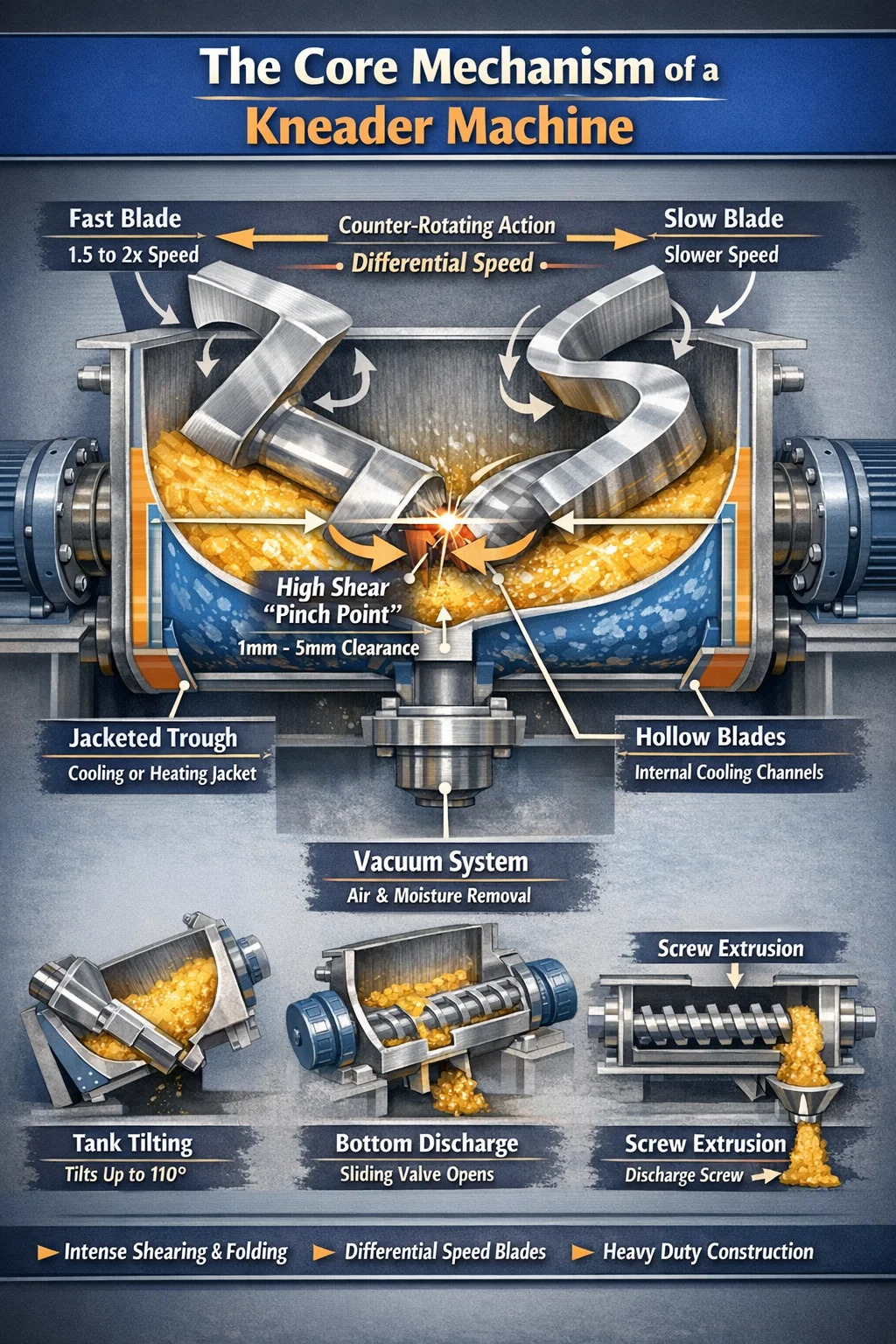
A kneader machine works by utilizing a pair of counter-rotating blades (typically Z-shaped or Sigma blades) that operate at different speeds within a W-shaped trough. The primary objective is to subject high-viscosity or semi-solid materials to intense shearing, folding, and compression. Unlike standard mixers that merely move material, a kneader forces the substance through narrow clearances between the blades and the trough walls, ensuring a homogeneous blend of ingredients that are otherwise resistant to flow.
Differential Speed and Counter-Rotation
The heart of the kneader machine lies in its blade dynamics. Most industrial units employ two horizontal shafts. These shafts do not spin at the same rate; usually, a ratio of 1.5:1 or 2:1 is applied between the "fast" blade and the "slow" blade.
Why Differential Speed Matters
As the blades rotate toward each other, the differential speed creates a "wiping" action. This prevents the material from simply sticking to a single blade and spinning in a circle. Instead, the material is constantly passed from one blade to the other, ensuring that every particle is subjected to the same amount of mechanical work.
In a standard 500-liter kneader machine, the blades may rotate at roughly 30 and 20 revolutions per minute respectively. This deliberate mismatch is what facilitates the folding action necessary for heavy rubbers, silicone sealants, and carbon pastes.
The Role of High Shear and Clearance
Mixing in a kneader machine occurs most intensely at the "pinch points." These are the microscopic gaps between the tip of the blade and the inner surface of the mixing trough.
- The clearance between the blade and the wall is typically kept between 1mm and 5mm, depending on the machine size.
- As the blade sweeps past the wall, it "shears" the material, breaking down agglomerates of powder or pigment.
- This shearing force is essential for dispersing fine particles into a thick polymer base, a task that a propeller or paddle mixer could never accomplish.
Thermodynamics and Temperature Management
Because a kneading machine does so much mechanical work, it generates a significant amount of friction-induced heat. Managing this temperature is critical for materials that might degrade or vulcanize prematurely.
| Feature | Mechanism | Purpose |
|---|---|---|
| Jacketed Trough | Double-wall construction | Circulating steam or cooling water |
| Hollow Blades | Internal fluid channels | Direct cooling of the core material |
| Vacuum System | Sealed chamber with pump | Removal of air bubbles and moisture |
Material Discharge Methods
Once the kneader machine has achieved the desired consistency, the material must be removed. Due to the high viscosity, this is not as simple as opening a valve. There are three primary ways this is handled:
- Tank Tilting: The entire U-shaped trough is tilted forward by a hydraulic system, usually up to 90 or 110 degrees, allowing the material to fall out.
- Bottom Discharge: A sliding valve or flap at the bottom of the trough opens, used for materials that still have some gravity-flow capability.
- Screw Extrusion: A discharge screw is located in a separate housing below the mixing blades. This screw can reverse during mixing to help the process and then run forward to extrude the finished product in a continuous strip or rope.
Structural Durability and Torque
The operation of a kneader machine requires massive torque. Industrial units use heavy-duty gearboxes and motors that can handle the resistance of materials like chewing gum base or BMC (Bulk Molding Compound). The shafts are often made of forged steel and the blades are reinforced with wear-resistant alloys to withstand the constant grinding and pulling forces of a 24/7 production cycle.