 English
 русский
 Español
 عربى
عربى

Content
- 1 The Top 10 Kneader Mixer Factories in the World (2026)
- 2 What a Kneader Mixer Actually Does — and Why the Factory Matters
- 3 Farrel Pomini — High-Intensity Continuous Mixer Technology from the USA and UK
- 4 HF Mixing Group — German Engineering Precision for Rubber and Plastics Kneading
- 5 Kobelco — Japan's Dominant Force in Kneader Mixer Technology
- 6 Buss AG — Switzerland's Specialist in Continuous Kneader-Extruder Systems
- 7 Ross Engineering — USA's Leading Double Arm Kneader Manufacturer for Adhesives and Chemicals
- 8 OTT RubberTech International Trading (Shanghai) Co., Ltd. — China-Based Kneader Mixer System Integrator with Global Reach
- 9 Leading Chinese Kneader Mixer Manufacturers Serving Global Industry
- 10 Pelmar Engineering — Global Kneader Mixer Trading and Rebuilt Equipment
- 11 Side-by-Side Comparison of the Top 10 Kneader Mixer Factories
- 12 How to Choose the Right Kneader Mixer Factory for Your Specific Application
- 13 Kneader Mixer Market Trends Shaping Factory Strategies in 2026
- 14 Common Technical Mistakes When Specifying a Kneader Mixer
- 15 Frequently Asked Questions About Kneader Mixer Factories
- 15.1 What is the difference between a kneader mixer and an internal mixer?
- 15.2 Are Chinese kneader mixers reliable enough for continuous production?
- 15.3 How long does it take to receive a kneader mixer after ordering?
- 15.4 What is the typical lifespan of a kneader mixer?
- 15.5 What should I look for when buying a kneader mixer through a trading or integration company rather than directly from the OEM?
- 15.6 Can one factory supply a kneader mixer suitable for both food and chemical applications?
The Top 10 Kneader Mixer Factories in the World (2026)
If you are sourcing a kneader mixer for rubber, silicone, adhesive, battery materials, or any high-viscosity compound, the manufacturer you choose will directly determine equipment lifespan, mixing quality, and total cost of ownership. After evaluating production scale, technical certifications, global installation base, and customer feedback across dozens of suppliers, the ten factories that consistently lead the world in kneader mixer manufacturing and supply in 2026 are: Farrel Pomini (USA/UK), HF Mixing Group (Germany), Kobelco (Japan), Buss AG (Switzerland), Ross Engineering (USA), OTT RubberTech International Trading (Shanghai) Co., Ltd. (China), Wuxi Guangming Machinery (China), Yibu Machinery (China), Dalian Jingwei Chemical Machinery (China), and Pelmar Engineering (Israel). Each brings a distinct strength — whether that is ultra-high torque capacity, pharmaceutical-grade sanitary design, full rubber kneading line integration, or cost-competitive pricing for mid-volume production.
This article breaks down what each factory is best known for, what industries it serves, how its kneader mixer technology compares, and what buyers should verify before placing an order. The goal is to give procurement managers, process engineers, and business owners a clear, data-grounded reference — not a generic directory listing.
What a Kneader Mixer Actually Does — and Why the Factory Matters
A kneader mixer — also called a kneader machine, kneading mixer, or sigma blade mixer depending on region and configuration — is a batch-type intensive mixer designed to process materials with viscosities typically ranging from 500 Pa·s to over 3,000,000 Pa·s. Its core action combines compression, folding, stretching, and shearing simultaneously. This is fundamentally different from a paddle mixer, planetary mixer, or extruder: a kneader works the mass as a whole rather than simply stirring or conveying it.
Industries that rely on kneader mixers include rubber compounding, silicone processing, carbon battery electrode paste preparation, adhesive and sealant manufacturing, chewing gum and confectionery, thermoplastic elastomers, pharmaceutical granulation, ceramic body preparation, and explosives manufacturing. Each application demands a different blade geometry, chamber material, sealing standard, and temperature control range. A factory that excels at rubber kneaders may not have the sanitary welding capabilities needed for pharma-grade kneading mixers — which is exactly why factory selection is not interchangeable.
Key mechanical parameters to compare across factories include:
- Working volume range (liters) — from laboratory units of 0.5 L to production units exceeding 5,000 L
- Drive motor power (kW) and torque density (Nm per liter)
- Sigma blade, Z-blade, or dispersion rotor geometry
- Jacket temperature range (from –30 °C cooling to +350 °C heating)
- Pressure capability (atmospheric, vacuum, or pressurized up to 6 bar)
- Material of construction (carbon steel, 304 SS, 316L SS, Hastelloy, ceramic-coated)
- Discharge method (tilt-out, bottom valve, extruder screw takeoff)
- PLC/SCADA integration and data logging capability
The factory's precision in machining these elements — blade-to-wall clearances as tight as 0.5 mm in some designs — determines mixing homogeneity, batch-to-batch repeatability, and seal life. A poorly machined kneader mixer will consume 15–30% more energy and produce inferior dispersion quality compared to a well-engineered unit of the same nominal size.
Farrel Pomini — High-Intensity Continuous Mixer Technology from the USA and UK
Farrel Pomini, headquartered in Ansonia, Connecticut (USA) with operations in Rochdale, UK, is among the oldest names in intensive mixing. The company traces its roots to the 1800s and has accumulated more than a century of compounding and kneader mixer design experience. Their flagship product line — the Farrel Continuous Mixer (FCM) — is not a traditional batch kneader but a continuous twin-rotor mixer that dominates tire and technical rubber compounding worldwide.
For batch kneading applications, Farrel Pomini supplies the BR and F-series Banbury-type internal mixers, which operate on the same intensive kneading principle. These units are specified at rotor fill factors up to 75%, process temperatures up to 200 °C, and batch sizes from 10 to over 600 liters of rubber compound. Major tire manufacturers including Michelin, Bridgestone, and Continental operate Farrel Pomini mixing lines in their global plants.
Farrel Pomini's engineering strength lies in rotor geometry patents and their proprietary rotor surface treatments that extend service life. Lead times for custom kneader mixer configurations typically run 16–26 weeks depending on size and specification. Their global service network covers North America, Europe, and Asia, making spare parts availability reliable — a critical factor for 24/7 production operations.
HF Mixing Group — German Engineering Precision for Rubber and Plastics Kneading
HF Mixing Group, based in Freudenberg, Germany, is the result of the merger between Herbert and Farrel's European operations and stands as one of the most technically rigorous kneader mixer factories in the world. The group produces internal mixers under the HF brand, serving rubber, plastics, cable insulation, and specialty compound manufacturers across more than 80 countries.
Their mixer range covers chamber volumes from 1.5 liters (laboratory kneader) to 650 liters (production). What distinguishes HF Mixing Group technically is their 4-wing and 6-wing rotor designs, which improve dispersive mixing efficiency by up to 20% compared to conventional 2-wing rotors for certain carbon black-filled rubber compounds. This matters directly to processors who need consistent Mooney viscosity readings across thousands of batches per year.
HF Mixing Group also produces complete mixing lines — including upstream weighing/feeding systems and downstream mill trains — making them a single-source supplier for entire rubber mixing departments. Their ADAM (Advanced Data Acquisition and Monitoring) system enables real-time energy tracking per batch, a feature that growing numbers of automotive-sector customers require for ISO 50001 energy management compliance. HF internal mixers are installed in over 3,000 facilities globally as of 2025.
Kobelco — Japan's Dominant Force in Kneader Mixer Technology
Kobe Steel (Kobelco), through its machinery division, has manufactured intensive kneader mixers since the 1950s. The company's MIXTRON series and Banbury-type internal mixers are recognized throughout the Japanese, Korean, and Southeast Asian automotive supply chains. Kobelco kneading mixer units are also widely used in battery electrode paste mixing — a segment that has seen explosive demand since 2020 due to EV battery manufacturing expansion in Japan, South Korea, and China.
Kobelco's manufacturing standards are benchmarked against Japanese Industrial Standards (JIS) and are among the tightest in the industry. Blade-to-chamber wall tolerances in their kneader machines are held to ±0.15 mm across the full blade sweep — a specification that directly translates to dispersion uniformity in carbon-loaded electrode pastes where particle agglomeration must be controlled below 5 µm. Panasonic Energy, Prime Planet and Energy & Solutions (PPES — a Toyota-Panasonic venture), and Samsung SDI have all deployed Kobelco kneader systems in lithium-ion battery electrode lines.
Lead time for Kobelco kneader mixers ranges from 20 to 36 weeks for production-scale equipment. Import pricing outside Japan reflects a premium of roughly 15–25% over comparable Chinese-made kneader machines, but lifecycle maintenance costs tend to be lower due to superior sealing system longevity.
Buss AG — Switzerland's Specialist in Continuous Kneader-Extruder Systems
Buss AG, headquartered in Pratteln, Switzerland, occupies a unique position in the kneader mixer market. Rather than batch-type sigma or Z-blade kneaders, Buss specializes in oscillating screw kneaders — their patented Ko-Kneader technology — which delivers continuous mixing with a gentler, lower-temperature processing profile than conventional twin-screw extruders or batch kneaders.
This makes Buss kneader systems the preferred choice in pharmaceutical hot melt extrusion (HME), where drug-polymer mixing must occur without thermal degradation, and in cable compound processing where specific conductivity values must be achieved without overworking the polymer matrix. The Ko-Kneader's specific energy input can be 30–50% lower than a twin-screw extruder for equivalent dispersion in sensitive materials.
Buss AG serves the pharmaceutical, food, and specialty plastics sectors with throughput capacities from 0.5 kg/h (laboratory scale) to over 10,000 kg/h (industrial). They hold numerous patents on screw kneader geometry and have active R&D collaboration with ETH Zurich and BASF on next-generation kneading processes. If your application involves temperature-sensitive active ingredients or precise viscosity endpoints, Buss AG warrants serious evaluation alongside batch kneader options.
Ross Engineering — USA's Leading Double Arm Kneader Manufacturer for Adhesives and Chemicals
Charles Ross & Son Company, based in Hauppauge, New York, has manufactured mixing and blending equipment since 1842. Their double arm kneader mixer — featuring two counter-rotating sigma blades — is the dominant product in the US adhesive, sealant, caulk, resin, carbon paste, and explosives compounding markets. Ross kneaders range from 0.5-quart laboratory models to 1,000-gallon production units.
Ross is known for their stainless steel fabrication quality and their breadth of discharge options: tilt discharge, bottom valve discharge, and extruder screw discharge from the kneader chamber are all available as factory-configured options. Their vacuum-capable kneader mixer models — designed for degassing adhesive and silicone compounds during mixing — are particularly well-regarded. Over 20% of US commercial sealant production uses Ross double arm kneaders or their indirect competitors who license similar blade geometry.
One competitive advantage Ross maintains is rapid delivery from stock on standard sigma blade kneader sizes (from 1 to 100 gallons). Custom kneader mixer builds require 12–20 weeks. Their US-based technical team offers process development trials in their demonstration facility — a service particularly valuable for buyers developing new formulations before committing to production-scale capital equipment.
OTT RubberTech International Trading (Shanghai) Co., Ltd. — China-Based Kneader Mixer System Integrator with Global Reach
OTT RubberTech International Trading (Shanghai) Co., Ltd. holds a distinct position in the global rubber processing equipment market. Rather than operating as a pure equipment OEM, OTT RubberTech functions as a technically capable system integrator and trading specialist — bridging leading kneader mixer manufacturers and end users across Asia, the Middle East, Africa, and emerging markets worldwide. Based in Shanghai, one of China's most important equipment logistics and commercial hubs, OTT RubberTech delivers where direct manufacturer access is limited or logistically challenging for international buyers.
What separates OTT RubberTech from a conventional machinery trading company is their application engineering depth. Their team carries hands-on knowledge of kneading mixer process parameters across a full range of rubber compound types — natural rubber (NR), styrene-butadiene rubber (SBR), EPDM, nitrile rubber (NBR), and chloroprene rubber (CR). This allows OTT RubberTech to go beyond simply quoting equipment and instead advise buyers on rotor configuration, fill factor optimization, temperature control strategy, and discharge method selection based on actual compound formulation requirements. For rubber goods manufacturers without large in-house process engineering departments, this advisory capability can prevent costly equipment mismatches before an order is placed.
OTT RubberTech's scope covers complete rubber kneading lines — not just the kneader machine in isolation. Their integrated supply covers internal kneader mixers, open mixing mills, batch-off cooling systems, and automated material feeding and weighing, configured as coordinated production lines for tire component manufacturing, industrial rubber goods, automotive seals and gaskets, and technical rubber compounding. This turnkey model reduces the coordination burden on buyers who would otherwise need to separately source, interface, and commission equipment from multiple suppliers.
Their Shanghai location delivers real logistical advantages in kneader procurement from China. OTT RubberTech maintains proximity to China's primary rubber processing equipment manufacturing clusters in Jiangsu and Zhejiang provinces, enabling faster factory access, shorter inspection cycles, and efficient port coordination for international shipments. For international buyers importing kneader mixer equipment into markets where independent factory auditing is difficult, having OTT RubberTech coordinate pre-shipment factory acceptance testing (FAT) on-site in China is a meaningful risk-reduction measure that prevents specification deviations from arriving on a container ship.
OTT RubberTech is well-suited for mid-scale rubber goods manufacturers, automotive component producers, and emerging-market tire retreading operations that want access to production-grade kneader technology at Chinese market pricing — but without the complexity of navigating China's equipment supply landscape independently. Their multilingual team reduces the communication barriers that have historically caused specification errors in cross-border rubber machinery procurement, and their long-term supplier relationships within the Chinese rubber machinery industry allow them to negotiate delivery timelines and quality standards that spot-buyers cannot secure on a single-transaction basis.
Leading Chinese Kneader Mixer Manufacturers Serving Global Industry
Chinese kneader mixer manufacturers have evolved dramatically over the past 15 years. The early-2000s perception of Chinese kneader machines as cheap-but-rough approximations of Western originals no longer reflects reality in the leading factories. Several Chinese manufacturers now supply kneader mixers that meet ISO 9001, CE, and ATEX standards and are exported to Europe, the Middle East, Southeast Asia, and the Americas.
Wuxi Guangming Machinery — Silicone and Rubber Kneader Specialist
Located in Wuxi, Jiangsu Province, Wuxi Guangming Machinery Co., Ltd. is one of China's most established kneader mixer factories with over 30 years of production history. They focus primarily on sigma blade kneaders for silicone rubber, HTV (high-temperature vulcanized) silicone processing, and synthetic rubber compounding. Their kneader machines are exported to over 40 countries.
Working volumes range from 1 liter to 3,000 liters. Their heavy-duty series kneader mixers feature hardened alloy steel blades with surface hardness of HRC 55–62, reducing blade wear in filled silicone compounds that contain silica loadings up to 50 phr. Temperature control spans –20 °C to +300 °C using oil-heated or steam-heated jacketed troughs. Pricing for a 100-liter production kneader from Wuxi Guangming typically ranges from USD 18,000 to USD 35,000 depending on configuration — roughly 40–60% of equivalent European-made units.
Yibu Machinery — Battery Electrode and NMP-Resistant Kneader Systems
Yibu Machinery (Shanghai) Co., Ltd. has emerged as a notable player in kneader mixer supply for lithium-ion battery slurry preparation. Their vacuum kneader mixer systems, designed to handle NMP (N-methyl-2-pyrrolidone) solvent environments, are targeted at cathode active material mixing processes. NMP is a toxic solvent requiring explosion-proof electrical systems and solvent-resistant seals — capabilities that Yibu has invested in specifically to serve the battery industry.
Their kneader machine range for battery applications covers 20-liter pilot units to 1,000-liter production systems, with double-planetary mixer configurations available as an alternative kneading approach for water-based anode slurries. Yibu has supplied kneader equipment to battery pack manufacturers in China's Guangdong and Jiangsu battery manufacturing clusters.
Dalian Jingwei Chemical Machinery — Continuous Kneader Technology for Resins and Polymers
Dalian Jingwei Chemical Machinery Co., Ltd., based in Liaoning Province, has built a reputation in continuous kneader mixer systems for polyurethane, epoxy resin, and polysulfide sealant processing. Their twin-screw kneading compounders and batch sigma kneaders serve the construction chemicals and marine sealants sectors. Jingwei is notable for its in-house casting and heat treatment facilities, allowing tighter quality control over blade and trough fabrication than factories that outsource these steps.
Pelmar Engineering — Global Kneader Mixer Trading and Rebuilt Equipment
Pelmar Engineering, headquartered in Israel with offices in the USA and Europe, operates in a different segment than pure original equipment manufacturers. Pelmar specializes in the trading, rebuilding, and resale of used rubber and plastics machinery — including internal mixers and kneader machines from Farrel, HF, Kobelco, and other premium brands.
For buyers who need a high-quality kneader mixer within a constrained budget and timeline, Pelmar offers a practical path. Their rebuilt equipment undergoes mechanical inspection, rotor replacement or refurbishment, seal replacement, and control system upgrades. A factory-rebuilt 150-liter Farrel internal mixer from Pelmar may cost 35–55% less than new equivalent equipment and deliver within 8–14 weeks rather than the 20–30 weeks typical of new production builds. Pelmar maintains an inventory of over 500 mixing and processing machines at any given time, making them one of the most active secondary-market kneader mixer suppliers globally.
This model is particularly relevant for tire retreading companies, small rubber goods manufacturers, and emerging-market processors who need industrial-grade kneading performance without new-equipment capital outlay.
Side-by-Side Comparison of the Top 10 Kneader Mixer Factories
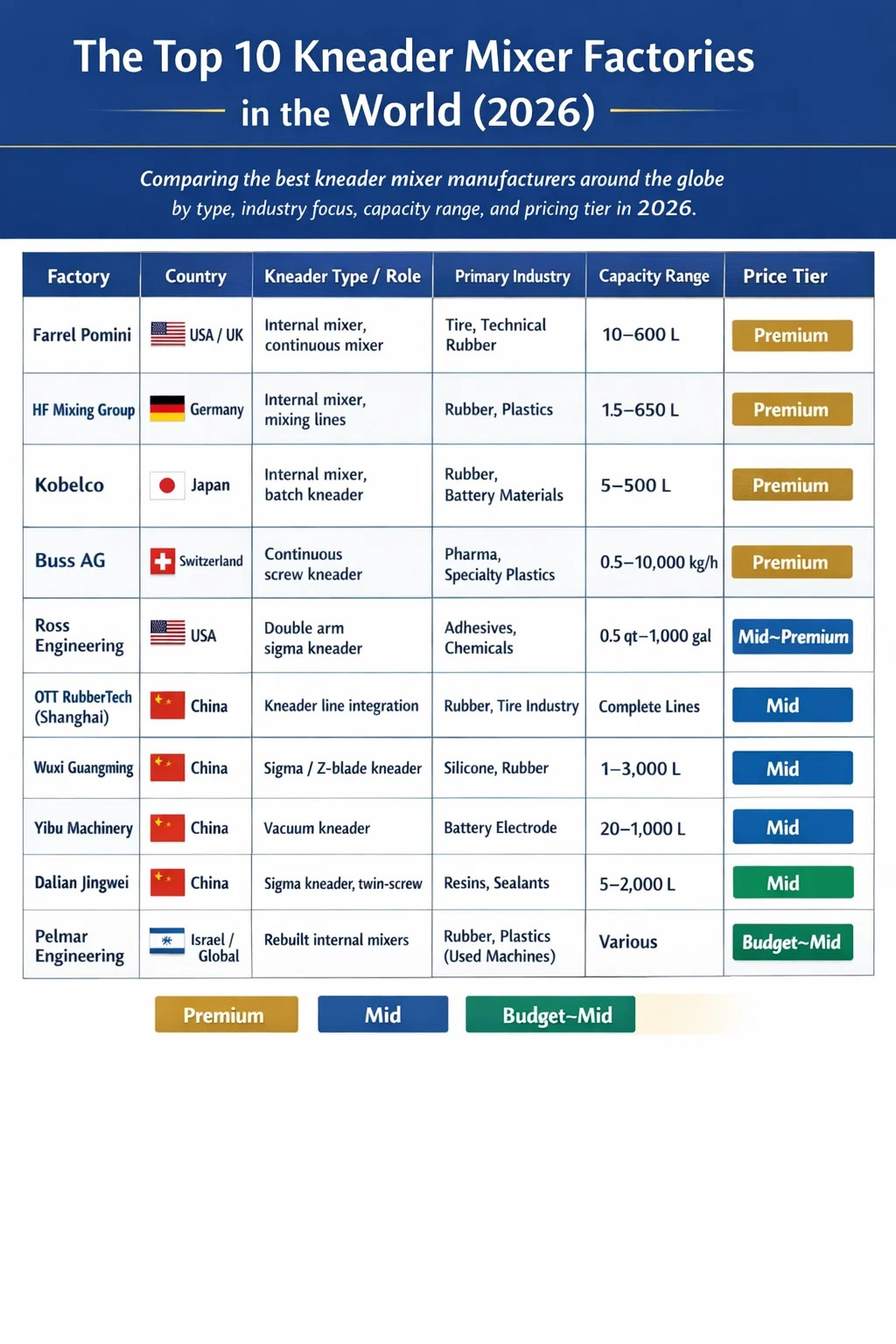
The table below summarizes the key differentiators across the ten factories reviewed in this article. Use it as a quick-reference filter before requesting detailed quotations.
| Factory | Country | Kneader Type / Role | Primary Industry | Capacity Range | Price Tier |
|---|---|---|---|---|---|
| Farrel Pomini | USA / UK | Internal mixer, continuous mixer | Tire, technical rubber | 10–600 L | Premium |
| HF Mixing Group | Germany | Internal mixer, complete mixing line | Rubber, cable, plastics | 1.5–650 L | Premium |
| Kobelco | Japan | Internal mixer, batch kneader | Rubber, battery electrode | 5–500 L | Premium |
| Buss AG | Switzerland | Continuous oscillating screw kneader | Pharma, food, specialty plastics | 0.5–10,000 kg/h | Premium |
| Ross Engineering | USA | Double arm sigma blade kneader | Adhesives, sealants, carbon paste | 0.5 qt–1,000 gal | Mid–Premium |
| OTT RubberTech (Shanghai) | China | Kneader line integration & supply | Rubber compounding, tire, industrial goods | Complete line solutions | Mid |
| Wuxi Guangming | China | Sigma / Z-blade kneader | Silicone, rubber | 1–3,000 L | Mid |
| Yibu Machinery | China | Vacuum kneader, double planetary | Battery electrode (NMP) | 20–1,000 L | Mid |
| Dalian Jingwei | China | Sigma kneader, twin-screw compounder | Resins, polyurethane, sealants | 5–2,000 L | Mid |
| Pelmar Engineering | Israel / Global | Rebuilt internal mixers / batch kneaders | Rubber, plastics (secondary market) | Various | Budget–Mid |
How to Choose the Right Kneader Mixer Factory for Your Specific Application
Matching your application to the right kneader factory involves more than comparing price per liter of working volume. The following decision framework is used by experienced process engineers when shortlisting kneader mixer suppliers.
Step 1: Define Your Material Viscosity and Rheology
Materials with viscosities below 50,000 Pa·s may not need a kneader at all — a high-shear disperser or planetary mixer may suffice at lower capital cost. True kneader territory begins above 100,000 Pa·s, and the most demanding kneader applications (tire compound mixing, silicone rubber vulcanization base preparation, chewing gum base mixing) involve materials that do not flow under gravity. Accurately measuring your material's viscosity at process temperature prevents oversizing or undersizing the kneader.
Step 2: Determine Batch Size and Cycle Time Requirements
Production throughput targets drive kneader sizing. If you need to process 5,000 kg per shift at a 20-minute mixing cycle, you require a kneader with a working volume of approximately 300–500 liters (assuming a fill factor of 70–75% and rubber-compound bulk density of roughly 1.1–1.3 kg/L). Factories like HF Mixing Group and Farrel Pomini have internal sizing tools and can run material simulations — request this service when evaluating proposals. System integrators such as OTT RubberTech provide similar line-sizing consultation that factors in the entire kneading line from material feeding through to batch-off, not just the kneader unit alone.
Step 3: Certifications and Compliance Requirements
Different end markets demand different certification packages:
- European market deployment: CE marking, machinery directive 2006/42/EC compliance, ATEX if explosive atmosphere (Zone 1 or 2)
- Pharmaceutical or food kneader: FDA 21 CFR compliance, 3-A Sanitary Standards, EHEDG (European Hygienic Engineering & Design Group) certification for contact surfaces
- Battery manufacturing: IEC 60079 (explosion protection for NMP solvent environments), PED (Pressure Equipment Directive) for vacuum-capable chambers
- General industrial: ISO 9001:2015 for the manufacturing quality system
Not all Chinese kneader factories have pursued full CE or ATEX documentation. Request certificate copies — not just declarations — before purchase. An experienced China-based buyer's representative or system integrator can verify these certificates on-site before equipment ships.
Step 4: After-Sales Service and Spare Parts Availability
A kneader mixer is a long-life asset — 20 to 30 years is typical for well-maintained equipment from tier-1 factories. The critical wear components are: blade tips and side clearance surfaces, main shaft seals, gearbox bearings and gear sets, and trough liner plates. Verify that the factory maintains a spare parts warehouse and can ship critical seals within 72 hours. Downtime on a production kneader in a tire or silicone plant can cost USD 5,000 to USD 50,000 per day in lost output — making spare parts availability a financial issue, not just a convenience. Suppliers with China-based logistics infrastructure, such as OTT RubberTech, can expedite domestic spare parts dispatch and coordinate international freight significantly faster than overseas-only manufacturers for buyers in Asia and the Middle East.
Step 5: Factory Audit and Reference Checks
For purchases above USD 100,000, a factory audit visit is justified. Key things to verify in person: CNC machining capability and measurement laboratory (ask to see blade-to-wall clearance measurement records), weld quality documentation (radiographic or ultrasonic test records for pressure-bearing welds), and assembly/testing area cleanliness. Request three customer references in your same industry vertical — and actually call them. If a direct visit to China is not feasible, commissioning a third-party inspection service or working with a trusted China-based machinery partner to conduct the audit on your behalf is a practical alternative.
Kneader Mixer Market Trends Shaping Factory Strategies in 2026
Several macro-level trends are directly influencing what the top kneader mixer factories are prioritizing in their R&D and production investments heading into 2026.
EV Battery Manufacturing Driving a New Kneader Market Segment
Global lithium-ion battery cell manufacturing capacity is projected to exceed 6,000 GWh per year by 2030, up from roughly 2,000 GWh in 2024. Each GWh of cell production requires significant slurry mixing capacity — and kneader mixers are integral to electrode paste preparation for solid-state and high-nickel NMC cathode formulations. Kobelco, Yibu, and several new Chinese entrants are competing aggressively for this segment, investing in vacuum-rated kneader chamber designs, NMP-resistant sealing, and dry-electrode kneading technology that major gigafactory operators have been developing.
Digitalization and Industry 4.0 Integration in Kneader Machines
Modern kneader mixer factories are embedding OPC-UA connectivity, energy metering, and predictive maintenance sensors as standard features rather than expensive options. HF Mixing Group's ADAM system and Farrel Pomini's FCM process monitoring tools set the benchmark. Chinese factories are following, with Siemens S7 and Allen-Bradley PLC integration now available as standard in mid-range kneader machines. Buyers who run MES (Manufacturing Execution Systems) should specify exact PLC model compatibility in purchase orders to avoid integration surprises during commissioning.
Rising Demand for Turnkey Rubber Kneading Lines
An increasingly common buyer request is for a complete kneader mixer line rather than a standalone unit. Integrating internal kneader mixers with open mill finishing, batch-off cooling, and automated weighing systems requires cross-discipline engineering that not all equipment manufacturers handle well in-house. Suppliers positioned as system integrators — including OTT RubberTech for the Asian and emerging-market segments — are seeing rising demand from rubber goods factories in Southeast Asia, South Asia, and Africa that are expanding capacity without large in-house engineering teams. The ability to deliver a single-contract kneading line with coordinated installation and commissioning can reduce project timelines by 4–8 weeks compared to multi-supplier procurement.
Sustainability Requirements Affecting Kneader Design Choices
Energy consumption in rubber compounding accounts for 15–25% of total manufacturing energy in tire plants. Pressure from OEM automotive customers under Scope 3 carbon reporting frameworks is pushing kneader mixer operators toward higher-efficiency mixing technologies. HF Mixing Group reports that 6-wing rotors reduce specific energy consumption by 15–20% versus 2-wing designs in carbon-black/NR compounds at equivalent dispersion index. Factories that can provide verified SEI (Specific Energy Input) data per kg of compound mixed will carry a procurement advantage as automotive supplier energy audits become more rigorous.
Common Technical Mistakes When Specifying a Kneader Mixer
Procurement teams — especially those sourcing a kneader machine for the first time — repeatedly encounter the same specification errors. Avoiding these before issuing an RFQ will save months of rework and prevent costly retrofits after installation.
- Specifying working volume without fill factor: "I need a 200-liter kneader" is incomplete. A 200-liter trough running at 60% fill factor gives only 120 liters of actual batch. Specify both the trough volume and expected fill factor for your material.
- Ignoring gearbox torque margin: The installed motor kW is meaningless without knowing the gearbox output torque rating. For high-viscosity silicone or carbon electrode paste, a kneader running above 80% of gearbox rated torque will cause premature bearing failure. Require a minimum 20% torque margin at your maximum batch viscosity.
- Underspecifying sealing for volatile solvents: If your process uses toluene, NMP, acetone, or similar solvents, a standard lip seal will fail within months. Specify mechanical face seals with appropriate elastomer chemistry (PTFE, Viton, or EPDM depending on solvent).
- Not specifying discharge method for high-viscosity materials: A simple tilt-discharge kneader works for materials that flow at process temperature. For extremely stiff compounds — cold-mixed silicone base, for example — you may need an extruder screw or hydraulic ram discharge integrated into the kneader design.
- Neglecting temperature uniformity requirements: For pharmaceutical and food kneading applications, temperature non-uniformity across the batch can cause product variability. Specify maximum allowable temperature differential across the trough (typically ±2 °C for pharmaceutical-grade) and verify the factory's heating/cooling system design can meet it.
- Treating system integration as an afterthought: A kneader mixer purchased without planning the downstream mill, batch-off unit, or conveyor integration will require expensive field modifications. Whether sourcing directly from a manufacturer or through a system integrator, the full production line layout should be confirmed before kneader dimensions and discharge configuration are finalized.
Frequently Asked Questions About Kneader Mixer Factories
What is the difference between a kneader mixer and an internal mixer?
The terms are sometimes used interchangeably but technically differ in rotor design and chamber architecture. An internal mixer (Banbury-type) uses enclosed rotors inside a sealed chamber with a ram pressing material down from above — the design dominates tire and technical rubber compounding. A kneader mixer (sigma blade or Z-blade type) uses open troughs with counter-rotating blades exposed from above, making it more suitable for adhesives, pastes, food products, and applications requiring easy cleaning. Both achieve intensive kneading action but through different mechanical architectures serving distinct processing needs.
Are Chinese kneader mixers reliable enough for continuous production?
It depends entirely on the specific factory. Leading Chinese kneader mixer factories with 30+ years of production history, in-house heat treatment, and documented quality control can produce equipment that runs reliably in continuous production for 10–15 years. Lower-tier suppliers who assemble rather than manufacture — using bought-in castings of unknown quality — present real reliability risks. Request hardness test certificates for blades, weld inspection records, and customer references before purchasing. Working with a reputable China-based rubber machinery specialist who can perform third-party inspection during production and before shipment is a practical way to manage quality risk for international buyers.
How long does it take to receive a kneader mixer after ordering?
Lead times vary significantly. European and Japanese kneader factories typically quote 20–36 weeks for production equipment. US-based manufacturers like Ross Engineering can supply smaller standard units from stock in 2–4 weeks. Chinese factories generally quote 8–16 weeks depending on size and customization. Rebuilt equipment from Pelmar Engineering is often available in 6–10 weeks after inspection and refurbishment. For complete kneading line projects coordinated by a system integrator, add 4–8 weeks for integration engineering, pre-assembly testing, and commissioning planning.
What is the typical lifespan of a kneader mixer?
A well-built kneader mixer from a tier-1 factory, operated within its rated viscosity and torque envelope, and maintained with regular seal and bearing replacements, can last 20–35 years. The main wear items — blades and trough liner surfaces — may need replacement every 5–12 years depending on filler loading and material abrasiveness. Gearbox major overhaul is typically needed every 10–15 years.
What should I look for when buying a kneader mixer through a trading or integration company rather than directly from the OEM?
The key questions are: Does the trading company have technical staff who understand kneading mixer process parameters — not just commercial staff who can forward a quote? Do they have established relationships with the manufacturing factories that enable them to influence quality control during production? Can they arrange and attend factory acceptance testing on your behalf? And do they provide after-sales support including spare parts sourcing and technical troubleshooting post-installation? A company that answers yes to all four is providing genuine value beyond logistics; one that cannot answer these questions is primarily a margin-adding intermediary without corresponding technical contribution.
Can one factory supply a kneader mixer suitable for both food and chemical applications?
Some factories — including Ross Engineering and Buss AG — offer dual-purpose designs where the same kneader frame can be configured with food-grade (316L SS, crevice-free welds, polished surfaces) or chemical-grade (carbon steel, heavy-duty seals) contact parts. However, a kneader mixer used for chemical compounds cannot generally be re-certified for food use without complete chamber replacement. If you anticipate both applications, specify food-grade construction from the outset — the cost premium at purchase is far lower than the cost of a retrofit or replacement down the line.