 English
 русский
 Español
 عربى
عربى

Content
- 1 What Kneading Actually Does to Dough
- 2 How a Dough Hook Works as a Kneader
- 3 Dough Hook vs. Hand Kneading: A Direct Comparison
- 4 When the Dough Hook Outperforms Hand Kneading
- 5 When a Dough Hook Falls Short
- 6 Choosing the Right Kneader for Your Baking
- 7 Practical Tips for Using a Dough Hook Effectively
- 8 The Role of Autolyse in Reducing Kneading Demands
- 9 No-Knead Methods as an Alternative to Both
- 10 Flour Type and Its Impact on Kneader Performance
- 11 Signs Your Dough Hook Is Not Kneading Properly
- 12 Final Verdict: When to Use a Dough Hook and When to Knead by Hand
Yes, a dough hook can replace hand kneading in most bread and pasta recipes — but with important caveats. A stand mixer fitted with a dough hook replicates the stretch-and-fold motion of hand kneading well enough to develop gluten networks comparable to those achieved by hand. However, the results depend heavily on dough hydration, mixer quality, speed settings, and the type of bread you're making. For everyday sandwich loaves, pizza dough, and enriched breads, a dough hook is a perfectly reliable substitute. For highly hydrated artisan sourdoughs or very delicate pastry doughs, the story gets more nuanced.
Understanding why the dough hook works — and when it falls short — requires a closer look at what kneading actually does to dough at a structural level, how different kneader attachments perform under real baking conditions, and what practical adjustments you need to make when switching from hands to machine.
What Kneading Actually Does to Dough
Kneading is not just about mixing ingredients together. Its primary function is to align and strengthen gluten strands — the protein network formed when glutenin and gliadin proteins in flour hydrate and bond. Without adequate kneading, gluten strands remain short, disorganized, and weak. The dough tears easily, holds gas poorly during fermentation, and produces bread with a dense, crumbly crumb.
A well-kneaded dough passes the "windowpane test": you can stretch a small piece of dough thin enough to see light through it without it tearing. This indicates that gluten strands are long, aligned, and elastic enough to trap carbon dioxide produced by yeast. Reaching this stage typically requires 8 to 12 minutes of vigorous hand kneading for a standard white bread dough.
Kneading also distributes yeast and salt evenly, encourages oxidation of the dough (which strengthens gluten further), and helps regulate dough temperature through the friction generated by working it. Each of these functions matters when you evaluate whether a dough hook or any mechanical kneader can truly replicate the process.
How a Dough Hook Works as a Kneader
A dough hook attachment — the spiral or C-shaped hook found on stand mixers — works by dragging dough around the bowl while simultaneously folding it against itself. This motion mimics the push-and-fold action of hand kneading, though not perfectly. The hook pulls dough from the outer edge of the bowl, stretches it upward, and folds it back down, repeating this cycle continuously.
Most household stand mixers operate their dough hook at speeds between 60 and 100 RPM on their lowest or second-lowest settings — the two speeds recommended for kneading. Running a dough hook at high speed creates excessive friction heat and can overwork the gluten, resulting in a slack, sticky dough that loses structure.
Spiral vs. C-Hook Designs
Not all dough hooks are equal. The two dominant designs have meaningfully different performance profiles:
- Spiral hooks (found on KitchenAid Pro and most commercial-grade mixers) maintain more consistent contact with the dough throughout the rotation. They push dough against the bottom of the bowl rather than letting it ride up the attachment, which produces more uniform gluten development.
- C-hooks (found on entry-level and tilt-head stand mixers) sometimes allow dough to climb up the attachment rather than being worked through the bowl. This "dough climbing" issue is common with sticky, high-hydration doughs and reduces kneading efficiency significantly.
In controlled baking tests, spiral hook mixers consistently develop gluten to windowpane stage in 6 to 8 minutes at speed 2, while C-hooks on the same dough may require 10 to 14 minutes — and sometimes never reach equivalent development on doughs above 70% hydration.
Dough Hook vs. Hand Kneading: A Direct Comparison
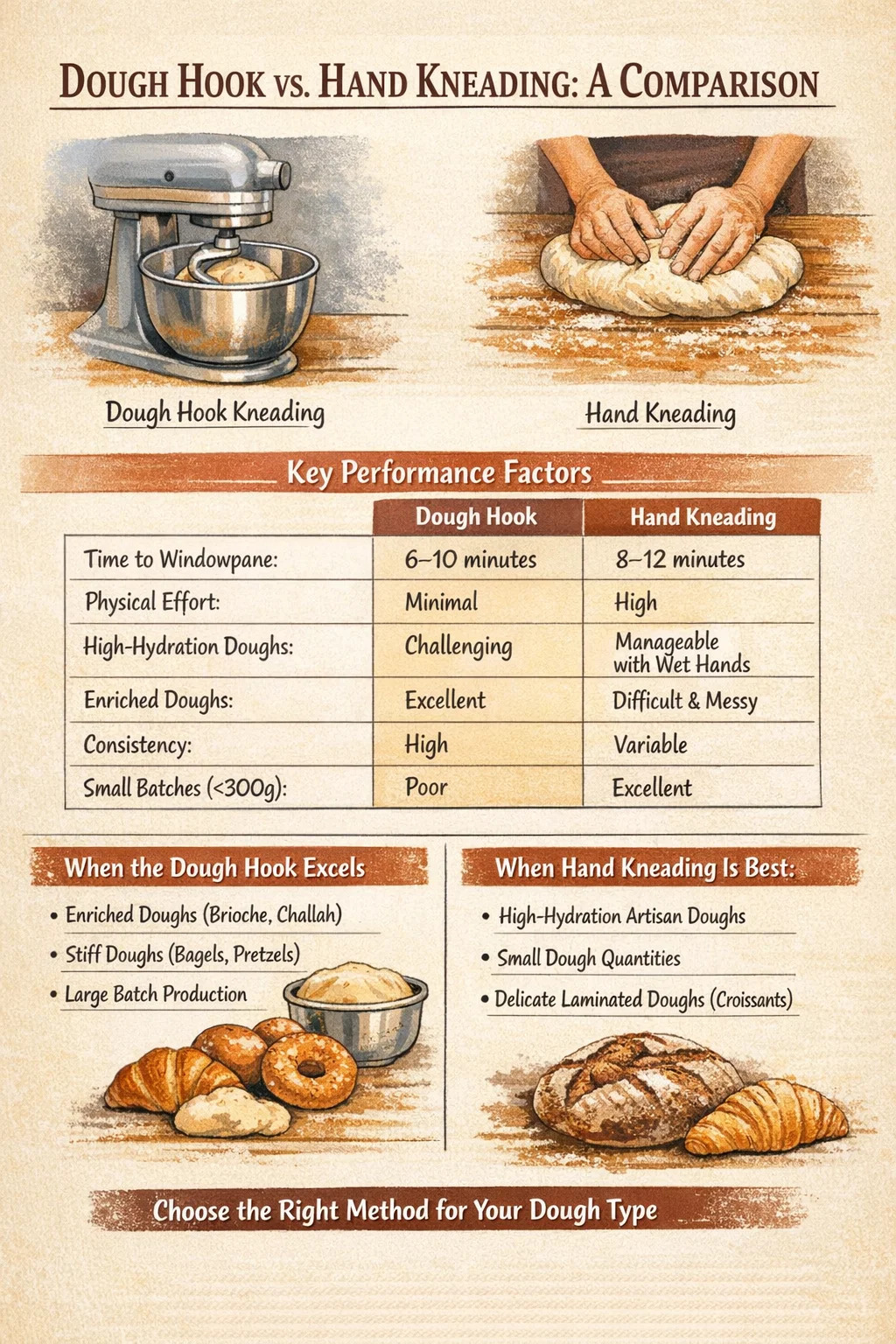
Both methods can produce excellent bread. The differences come down to control, time, effort, and the specific demands of the dough you're working with.
| Factor | Dough Hook (Kneader) | Hand Kneading |
|---|---|---|
| Time to windowpane | 6–10 minutes | 8–12 minutes |
| Physical effort | Minimal | High |
| Dough temperature control | Risk of overheating at high speeds | Natural tactile feedback |
| High-hydration doughs (75%+) | Challenging, risk of dough climbing | Manageable with wet hands |
| Enriched doughs (brioche, etc.) | Excellent — handles fat incorporation well | Very difficult, sticky and messy |
| Consistency across batches | High | Variable (fatigue, technique) |
| Small dough batches (<300g flour) | Poor — dough doesn't reach hook properly | Excellent |
When the Dough Hook Outperforms Hand Kneading
There are specific dough types where a mechanical kneader doesn't just match hand kneading — it genuinely produces better results.
Enriched Doughs Like Brioche and Challah
Brioche requires incorporating large amounts of cold butter into a developed gluten network — sometimes as much as 50% butter by flour weight. The butter must be added in small pieces after initial gluten development, and the dough needs sustained kneading to fully emulsify the fat into the structure. Doing this by hand is exhausting and often results in butter melting from body heat before it properly incorporates. A stand mixer with a dough hook handles this without any temperature issues, particularly when the bowl and hook are pre-chilled.
Large Batch Production
When making multiple loaves — say, three to four at once using 1.5 to 2 kg of flour — hand kneading becomes physically taxing enough to introduce inconsistency. Fatigue leads to uneven gluten development, especially in the second or third batch. A kneader maintains consistent speed and pressure throughout, producing uniform dough every time regardless of batch size (within the mixer's rated capacity).
Stiff Doughs for Bagels and Pretzels
Bagel dough typically runs at 55 to 60% hydration — extremely stiff compared to standard bread dough. Kneading this by hand for the required 15 to 20 minutes is genuinely difficult and can cause wrist and hand strain. A stand mixer with a dough hook handles the resistance mechanically without compromising gluten development, and it does so consistently batch after batch.
When a Dough Hook Falls Short
The dough hook is not a universal replacement. Several scenarios call for hand kneading or alternative techniques.
Very High Hydration Artisan Doughs
Open-crumb sourdoughs, ciabatta, and focaccia doughs often run at 75% to 85% hydration or higher. These doughs are so wet and extensible that a standard dough hook struggles to engage them properly. The dough tends to slap against the sides of the bowl or ride up the hook rather than being worked through it. Most professional bakers working with these hydration levels use a combination of autolyse (a 30- to 60-minute rest after initial mixing that allows hydration without kneading), followed by a series of stretch-and-fold cycles during bulk fermentation rather than intensive machine kneading.
Small Dough Quantities
Most household stand mixers require a minimum of roughly 300g to 400g of flour for the dough hook to function properly. Below this threshold, the dough mass is too small to be caught and worked by the hook — it just sits in the bottom of the bowl being pushed around rather than stretched and folded. For small batches like a single personal pizza or one small loaf, hand kneading is simply more effective.
Delicate Laminated Doughs
Croissant and Danish dough rely on lamination — the mechanical creation of hundreds of alternating layers of dough and butter through repeated folding — rather than gluten development through kneading. Over-kneading these doughs before lamination actually works against you by making the gluten too strong and elastic, causing it to spring back during rolling and making lamination difficult. The dough hook is not suitable here, and neither is intensive hand kneading. A brief mix just until combined, followed by a long cold rest, is the correct approach.
Choosing the Right Kneader for Your Baking
Beyond the stand mixer dough hook, several other kneader types exist, each suited to different baking volumes and dough types.
Household Stand Mixers
KitchenAid, Ankarsrum, Kenwood, and Bosch are the dominant brands in the home baker market. The Ankarsrum Original uses a roller-and-scraper system rather than a conventional hook, which many bakers argue produces superior gluten development — particularly for high-hydration doughs — because the roller presses and stretches the dough against the bowl wall in a motion closer to true hand kneading. The KitchenAid Pro series with its spiral hook handles standard bread doughs reliably up to about 1.3 kg of dough per batch.
Dedicated Spiral Kneader Machines
Professional bakeries and serious home bakers who produce large volumes often invest in dedicated spiral kneader machines. These units — such as those made by Famag, Santos, or Häussler — have a rotating bowl combined with a spiral hook, which produces a kneading action much closer to hand folding than a fixed-bowl stand mixer. They handle doughs from 60% to 85% hydration equally well and operate at lower RPMs with greater torque, reducing heat buildup during kneading. Entry-level models suitable for home use start around $500 to $800.
Bread Machines as Kneaders
Many bakers use the kneading cycle of a bread machine purely for dough development, then remove the dough for hand shaping and oven baking. This is a legitimate and effective strategy. Most bread machines run their kneading cycle for 20 to 25 minutes — longer than necessary for most doughs — but the result is consistently well-developed gluten at the cost of some overworking in recipes that call for shorter knead times.
Practical Tips for Using a Dough Hook Effectively
Getting the best results from a kneader attachment requires more than just turning on the machine and walking away. Several adjustments improve output significantly.
- Use speed 2, not speed 1. Speed 1 on most stand mixers is often too slow to generate the friction and folding motion needed for proper gluten development. Speed 2 hits the optimal range for most bread doughs. Speed 3 and above generate too much heat and can break down gluten structure.
- Monitor dough temperature. Target a finished dough temperature of 24°C to 27°C (75°F to 80°F). If your dough is warming above this range during kneading, the mixer is running too fast or too long. Use cold water in summer to compensate.
- Do the windowpane test regardless of time. Recipes give time ranges, but your specific flour, hydration, and mixer may behave differently. Pull a small piece of dough after 6 minutes and stretch it. If it tears before becoming translucent, knead for another 2 to 3 minutes and test again.
- Don't add flour to fix stickiness mid-knead. Sticky dough during machine kneading is usually not a problem — the dough will come together and pull away from the bowl sides within 3 to 4 minutes as gluten develops. Adding flour to compensate produces a dry, dense final product. Only adjust hydration at the beginning of mixing.
- Let the mixer rest for large batches. Consumer-grade stand mixers are not designed for continuous kneading of maximum-capacity dough loads. If kneading a full 1 kg batch at speed 2 for more than 8 minutes, allow the mixer motor a 2-minute rest to prevent overheating.
- For enriched doughs, add fat after initial gluten development. Incorporate butter or oil only after the dough has kneaded for at least 5 minutes and has developed some structure. Fat added too early coats the flour proteins and inhibits gluten formation entirely.
The Role of Autolyse in Reducing Kneading Demands
Autolyse is a technique worth understanding because it directly reduces how much kneading — by hand or machine — a dough actually needs. Developed by French baker Raymond Calvel, the method involves mixing only flour and water (no yeast or salt) and letting the mixture rest for 20 to 60 minutes before adding remaining ingredients and beginning kneading.
During autolyse, gluten bonds form spontaneously through hydration alone, without any mechanical input. Proteases in the flour also begin breaking down gluten slightly, improving extensibility. The result is that kneading time after autolyse can be reduced by 30% to 50% compared to doughs mixed and kneaded without a rest period. For a dough hook, this means less time at speed, less motor strain, and reduced heat buildup — a practical benefit when working with doughs that approach your mixer's capacity limits.
No-Knead Methods as an Alternative to Both
It's worth acknowledging that for many home bakers, neither a dough hook nor hand kneading is necessary. The no-knead method — popularized by Jim Lahey and covered extensively in the New York Times in 2006 — produces excellent open-crumb bread by substituting time for mechanical work. A very wet dough (typically 75% to 80% hydration) is mixed briefly just until combined, then left to rest for 12 to 18 hours at room temperature. During this long fermentation, gluten develops passively, and the high carbon dioxide environment from yeast activity contributes to an open, irregular crumb that many bakers prefer for rustic loaves.
This approach works beautifully for simple boule-style breads baked in a Dutch oven, but it doesn't translate well to enriched doughs, shaped loaves requiring tight structure, or any recipe where timing matters more than convenience. For those, a kneader remains the practical tool of choice.
Flour Type and Its Impact on Kneader Performance
The flour you use affects how well a dough hook performs. Protein content is the critical variable.
| Flour Type | Protein Content | Kneader Performance | Notes |
|---|---|---|---|
| Bread flour | 12–14% | Excellent | Strong gluten responds well to hook kneading |
| All-purpose flour | 10–12% | Good | May need 1–2 extra minutes vs. bread flour |
| Whole wheat flour | 13–14% | Good, but tricky | Bran cuts gluten strands; avoid over-kneading |
| Spelt flour | 12–13% | Moderate | Fragile gluten; limit hook kneading to 5–6 min |
| Rye flour | 8–10% | Limited | No meaningful gluten; stir rather than knead |
| Cake / pastry flour | 7–9% | Not recommended | Low protein means minimal gluten to develop |
Spelt deserves special attention because it is frequently used in health-conscious baking but behaves very differently from wheat under mechanical kneading. Spelt gluten is more extensible but less elastic than wheat gluten — it stretches further but snaps back less. Over-kneading spelt dough, particularly with a machine kneader that applies consistent pressure without the tactile feedback of hand kneading, is a common mistake that results in a loose, incoherent dough structure that collapses during baking.
Signs Your Dough Hook Is Not Kneading Properly
Recognizing when your kneader is failing to do its job properly saves you from baking a loaf that disappoints despite following a recipe to the letter.
- Dough climbing the hook: If dough wraps around the hook and rides up rather than working through the bowl, stop the machine, remove the dough, reshape it into a ball, and restart. This often indicates the dough is too soft for the hook design, or the bowl is overloaded.
- Dough not clearing the bowl sides: Properly developing dough should pull away from the sides of the bowl by the 4- to 5-minute mark. If it's still sticking to the sides after 8 minutes, the dough may be too hydrated for the hook to manage, or flour addition was insufficient at the outset.
- Dough tears rather than stretches: If the windowpane test consistently fails after 10 to 12 minutes of kneading with no improvement, the flour protein content may be too low, or the dough may be too cold. A cold dough (below 18°C) resists gluten development significantly.
- Excessive heat: Dough that reaches 30°C or above during kneading has been overworked or the mixer speed was too high. Yeast becomes hyperactive and then dies at these temperatures, compromising fermentation. If this happens, refrigerate the dough immediately for 20 to 30 minutes before continuing.
Final Verdict: When to Use a Dough Hook and When to Knead by Hand
A dough hook is a reliable, practical replacement for hand kneading in the vast majority of bread baking scenarios. For standard bread doughs in the 60% to 72% hydration range, enriched doughs, stiff doughs, and large-batch production, it delivers equivalent or superior results with far less physical effort. The key is using the right speed, monitoring dough temperature, and verifying development with the windowpane test rather than relying solely on timing.
Hand kneading retains its edge for small batches, very high hydration artisan doughs that benefit more from folding techniques, and doughs made with fragile gluten like spelt where tactile feedback matters more than mechanical consistency. For those who bake frequently and in volume, investing in a quality kneader — whether a spiral-hook stand mixer or a dedicated spiral kneader machine — is one of the most impactful upgrades you can make to your baking workflow.
The machine does not replace the baker's judgment. Knowing your dough, reading its texture, and testing for proper development are skills that remain essential regardless of whether a hook or a pair of hands is doing the mechanical work.