 English
 русский
 Español
 عربى
عربى

Content
- 1 The Core Mechanics Inside a Dough Kneader
- 2 Types of Dough Kneaders and How Each One Operates
- 3 What Happens to Gluten During Kneading
- 4 Key Components of a Dough Kneader Machine
- 5 Kneading Speed, Time, and Their Effect on Dough Quality
- 6 Industrial Dough Kneader vs Commercial vs Home Kneader
- 7 Factors That Affect Kneading Performance
- 8 Maintenance and Hygiene of Dough Kneader Machines
- 9 Choosing the Right Dough Kneader for Your Application
A dough kneader works by applying repeated mechanical pressure, folding, and stretching motions to raw dough, mimicking the hand-kneading technique used in traditional baking. The machine drives one or more shaped agitators — typically spiral hooks, planetary beaters, or sigma blades — through the dough mass at controlled speeds, continuously working gluten proteins until they align into an elastic, cohesive network. This mechanical development of gluten is the single most critical function of any kneader, and understanding how each component contributes to that process helps bakers, food manufacturers, and equipment buyers make better decisions.
Whether you're operating a small spiral kneader in a neighborhood bakery or running a continuous industrial dough kneader processing several tonnes per hour, the underlying physics and chemistry remain consistent. What changes is the scale, the agitator geometry, and the level of process control available to the operator.
The Core Mechanics Inside a Dough Kneader
At the heart of every kneader is a driven shaft connected to a shaped tool that moves through the dough. The motion is never random. Engineers design agitator paths to maximize the number of times dough folds back on itself per unit of time, because each fold event works the gluten strands a little further toward full development.
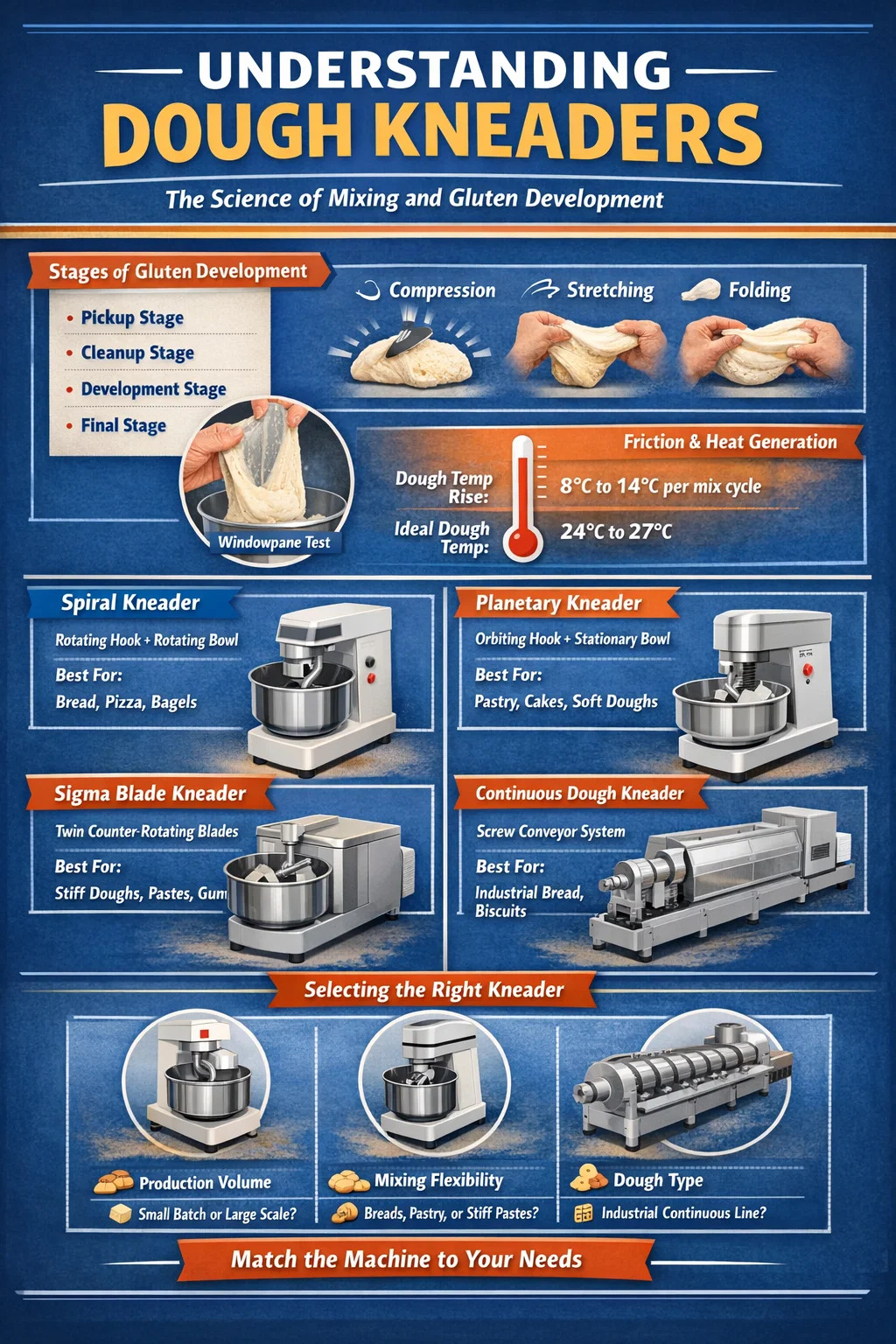
Three distinct mechanical actions happen simultaneously inside the bowl during kneading:
- Compression: The agitator pushes into the dough mass, compressing layers together and expelling large air pockets.
- Stretching: As the agitator moves forward, dough adhering to it gets pulled and elongated, aligning glutenin and gliadin molecules into longer chains.
- Folding: The dough wraps around the agitator and folds back onto itself, repeatedly layering the developing gluten network.
The combination of these three actions, repeated hundreds of times over a typical kneading cycle of 8 to 20 minutes, produces a dough with viscoelastic properties — meaning it both stretches (elastic) and flows slightly under sustained force (viscous). This balance is precisely what bread, pasta, and pizza doughs require to trap fermentation gases and hold their shape during baking.
The Role of Friction and Heat Generation
Mechanical work converts into heat. During intensive kneading, dough temperature can rise by 8°C to 14°C over the course of a single mix cycle if no temperature control is used. Industrial kneader machines address this through jacketed bowls circulating chilled water, keeping final dough temperature within a tight target range — typically 24°C to 27°C for most lean bread doughs. Exceeding 30°C risks premature yeast activation and enzyme degradation, which ruins dough extensibility.
Small commercial and home stand kneaders rely on the thermal mass of the bowl and ambient conditions to manage heat. This is one reason industrial bakers chill their water when working in warm environments, often targeting a water temperature calculated by the formula: desired dough temperature × 3 − (flour temperature + room temperature + friction factor).
Types of Dough Kneaders and How Each One Operates
Not all kneaders move in the same way. The agitator design fundamentally determines the style of mechanical work applied to the dough, which in turn determines what products the machine is best suited to produce.
Spiral Kneader (Spiral Mixer)
The spiral kneader is the dominant type in professional bread production worldwide. It uses a fixed spiral hook that rotates on its own axis while the bowl rotates in the opposite direction. This counter-rotation means every part of the dough mass passes through the narrow gap between the spiral and the dough breaker bar, receiving intense, focused mechanical work.
Spiral kneaders are highly efficient at developing gluten without excessive oxidation or heat generation. A typical artisan-style bread dough can reach full gluten development in 12 to 18 minutes in a spiral kneader operating at two speeds — a slow first speed (approximately 100–120 rpm bowl speed) for ingredient incorporation, followed by a faster second speed (approximately 200–240 rpm) for intensive development.
Because the bowl rotates, the dough is constantly repositioned beneath the spiral, ensuring even development across the entire batch. This makes spiral kneaders particularly well-suited to stiff and semi-stiff doughs: baguette, ciabatta (paradoxically, despite its high hydration), bagel dough, and pizza bases.
Planetary Kneader (Planetary Mixer)
In a planetary kneader, the agitator rotates on its own axis while simultaneously orbiting around the center of a stationary bowl — just like a planet around a star, hence the name. This geometry ensures the agitator traces every point inside the bowl over successive orbits, producing thorough incorporation without requiring a rotating bowl.
Planetary mixers are versatile: by swapping the dough hook for a flat beater or wire whisk, the same machine can handle creaming butter and sugar, whipping egg whites, or blending batters. This versatility makes them the go-to choice for pastry kitchens and confectionery production. However, for high-volume bread production, planetary kneaders are generally less efficient than spiral models because the stationary bowl creates dead zones near the bowl wall where dough can temporarily escape full mechanical action.
Sigma Blade (Twin-Arm) Kneader
The sigma blade kneader — also called a double-arm kneader or twin-rotor kneader — uses two interlocking sigma-shaped (or Z-shaped) blades rotating toward each other inside a trough-shaped bowl. The converging rotation creates a shearing zone in the center of the trough where dough is repeatedly folded, compressed, and pulled apart.
This type of kneader is particularly suited to very stiff doughs (such as hard candy compounds, chewing gum bases, and specialty pastes) and to applications requiring intensive mixing of high-viscosity materials. The sigma blade machine generates more heat per unit time than spiral kneaders, making temperature control more important. Many industrial sigma kneaders operate with a jacketed trough capable of both heating and cooling the product during mixing.
Continuous Dough Kneader
Industrial-scale continuous kneader machines operate on an entirely different principle from batch kneaders. Ingredients are metered in at one end of an enclosed chamber, and fully developed dough exits from the other end in a continuous stream. Inside, a long screw conveyor or a series of kneading pins applies mechanical work as the dough travels through the chamber.
Continuous kneaders can process between 500 kg and over 6,000 kg of dough per hour depending on the model, making them indispensable for large industrial bread and biscuit factories. The challenge with continuous kneading is that residence time in the chamber must be precisely controlled; any variation in ingredient feed rate directly affects gluten development in the finished dough.
| Kneader Type | Agitator Motion | Best Suited For | Typical Batch Size | Heat Generation |
|---|---|---|---|---|
| Spiral | Rotating hook + rotating bowl | Bread, pizza, bagels | 5 – 500 kg | Low–moderate |
| Planetary | Orbiting hook, stationary bowl | Pastry, cakes, soft doughs | 0.5 – 80 kg | Moderate |
| Sigma Blade | Twin counter-rotating blades | Stiff doughs, pastes, gum | 10 – 1,000 kg | High |
| Continuous | Screw conveyor or pin rotor | Industrial bread, biscuits | 500 – 6,000+ kg/hr | Variable (controlled) |
What Happens to Gluten During Kneading
Understanding what physically happens to flour proteins during the kneading process explains why the machine's motion matters so much. Wheat flour contains two key proteins — glutenin and gliadin — that are initially present as separate, tangled molecules. When water is added and mechanical energy is applied, these proteins hydrate and begin to bond with each other.
Glutenin molecules, which are large polymeric proteins, form the structural backbone. Gliadin molecules act as plasticizers, making the network extensible. Together they form gluten — a continuous, viscoelastic matrix that runs through the entire dough mass. The kneader's job is to accelerate and optimize the alignment and bonding of these proteins.
Stages of Gluten Development Under Mechanical Action
- Pickup stage (0–3 minutes): Flour and water are incorporated. The mixture looks shaggy and rough. No continuous gluten network exists yet.
- Cleanup stage (3–6 minutes): Dough begins to come together and clears the sides of the bowl. The gluten network is forming but still weak and easily torn.
- Development stage (6–14 minutes): The gluten network strengthens rapidly. Dough becomes smooth and elastic. Surface tension increases visibly. The dough passes the windowpane test — a small piece can be stretched into a thin, translucent membrane without tearing.
- Final stage (14–20 minutes, depending on formula): Full development. Dough is smooth, satiny, and extensible. Further kneading beyond this point in a high-speed machine can begin to degrade the gluten network through mechanical overwork.
The windowpane test is the standard field check used by bakers worldwide to confirm gluten development without laboratory equipment. Fully developed dough can be stretched to a membrane less than 0.5 mm thick without tearing, because the gluten network is continuous and well-oriented.
Key Components of a Dough Kneader Machine
Every kneader, regardless of size or type, is built from a set of core functional components. Knowing what each part does helps operators maintain equipment correctly and troubleshoot problems before they affect production quality.
The Bowl
The bowl holds the dough during mixing and, in spiral kneaders, rotates as part of the kneading action. Bowl capacity is the primary specification used to size kneaders for production requirements. As a general rule, dough should fill between 30% and 70% of the bowl's maximum capacity; overfilling prevents complete incorporation, while underfilling reduces the mechanical efficiency of the agitator's action.
Industrial bowls are fabricated from food-grade stainless steel (typically 304 or 316 grade) and are designed for rapid removal and replacement to minimize downtime between batches. Many systems use lift-and-tilt mechanisms to transfer dough to dividers or bulk fermentation containers without manual handling.
The Agitator (Hook, Spiral, or Blade)
The agitator is the functional heart of the kneader. Its geometry determines the shear rate, the folding frequency, and the type of mechanical stress applied to the dough. Spiral agitators are optimized for bread doughs and are shaped to push dough both downward and sideways, creating the characteristic wrapping and folding motion. Dough hooks in planetary mixers are typically J-shaped or corkscrew-shaped and rely on the orbital motion to ensure full bowl coverage.
Agitators are manufactured to very precise tolerances. The gap between the agitator and the bowl wall — typically 5 to 15 mm in commercial kneaders — is a deliberate design choice that controls the intensity of shear the dough experiences as it is forced through that narrow channel.
The Drive System
Kneaders require powerful, torque-rich motors because dough — especially stiff dough — offers high resistance to the agitator. A commercial 60-liter spiral kneader typically requires a motor in the range of 3 to 5.5 kW, while a 300-liter industrial unit may use a 22 kW or larger motor. Drive systems use gear reduction to convert high-speed motor rotation into the slower, high-torque agitator movement needed for effective kneading.
Variable frequency drives (VFDs) are increasingly standard on modern kneaders, allowing operators to adjust agitator speed electronically rather than switching between fixed mechanical gears. This enables more precise process control and gentler handling of delicate doughs like laminated croissant pastry.
The Dough Breaker Bar
Spiral kneaders include a fixed dough breaker bar positioned above the bowl. As the dough rotates with the bowl, this bar divides the dough mass and forces it back under the rotating spiral. This prevents the dough from spinning as a solid mass and ensures that every portion of the dough passes repeatedly through the zone of maximum mechanical action. Without this component, spiral kneaders would be far less efficient.
The Control Panel
Modern kneader machines integrate programmable controls that manage mixing time, speed transitions, dough temperature monitoring via bowl-mounted probes, and automatic stop functions. High-end industrial systems can store dozens of dough recipes and adjust mixing parameters in real time based on sensor feedback — for example, extending kneading time automatically if the dough temperature is lower than the target range at the end of the first speed phase.
Kneading Speed, Time, and Their Effect on Dough Quality
The relationship between kneading speed, duration, and final dough quality is not linear. More kneading is not always better. Optimal kneading intensity depends on the flour protein content, hydration level, intended bread characteristics, and the kneader type being used.
In French baking tradition, the concept of "bassinage" involves adding small amounts of extra water toward the end of kneading in a spiral kneader — the developed gluten network is strong enough by that point to absorb additional moisture that would have caused stickiness if added at the start. This technique exploits the time-dependent nature of gluten hydration and is only practical because of the controlled, reproducible action of the kneader.
Under-Kneading vs Over-Kneading
Under-kneaded dough has a weak, fragile gluten network. It tears easily when sheeted, produces bread with poor volume, dense crumb structure, and uneven texture. The crust may appear pale and the crumb gummy because the gluten could not adequately trap fermentation gases or structure the starch gelatinization process during baking.
Over-kneaded dough, particularly in high-speed intensive kneaders, suffers from mechanical breakdown of gluten bonds — sometimes called "going slack." The dough loses its elasticity, becomes sticky and difficult to shape, and produces bread with poor structural integrity. Industrial kneader operators use torque monitoring (measuring the electrical current draw of the motor) to detect the characteristic drop in resistance that signals maximum gluten development, automatically stopping the machine before over-kneading occurs.
Intensive vs Improved vs Autolyse Methods
Bakers and food technologists distinguish between several kneading methods based on the intensity of mechanical work applied:
- Intensive mixing: High speed throughout, typically 12–16 minutes in a spiral kneader. Produces highly oxidized, very white crumb. Used for large-scale sandwich bread production.
- Improved mixing: Moderate speed and duration, allowing some flavor and color development. Produces slightly creamy crumb with more complexity than intensive mixing.
- Short mixing / autolyse: Flour and water are mixed briefly, then rested for 20–60 minutes before salt and other ingredients are added and mixing resumes. During the rest, enzymatic action and passive hydration strengthen the gluten with minimal mechanical input. This method preserves more carotenoid pigments, producing a characteristic creamy-yellow crumb and more complex flavor.
The autolyse method was developed by French bread scientist Professor Raymond Calvel in the 1970s specifically to address the problem of over-oxidized crumb caused by intensive kneader use. By reducing mechanical work while still achieving full gluten development, bakers could produce bread with superior flavor and nutritional value compared to purely machine-intensive methods.
Industrial Dough Kneader vs Commercial vs Home Kneader
The principles of operation are identical across all scales, but practical differences in capability, durability, and control sophistication are substantial.
Home Stand Kneaders
Consumer stand kneaders — such as those with bowl capacities of 4.8 to 6.9 liters — use planetary motion with a spiral or J-hook attachment. Motor power typically ranges from 300 W to 600 W. These machines perform well with small dough batches (up to approximately 900 g of dough) but lack the torque to develop stiff doughs like bagel or pretzel dough without straining the motor. Most home kneader models do not include bowl temperature control, and the friction factor is higher relative to the dough mass compared to larger commercial machines.
Commercial Bakery Kneaders
Commercial spiral kneaders with bowl capacities from 20 to 200 liters are the workhorse of artisan and industrial bakeries. Motor power in the 2.2 kW to 15 kW range provides ample torque for full batches of stiff or enriched doughs. These machines are built for continuous daily use, with stainless steel construction, NSF food safety certification, and removable bowls for efficient batch changeover.
A standard 80-liter spiral kneader can process a batch of approximately 55 kg of bread dough in about 15 minutes, allowing a medium-sized bakery to produce several hundred kilograms of dough per hour with a single machine.
Industrial Dough Kneader Systems
Industrial dough kneader systems integrate the kneader into a fully automated production line. Automated weighing and dosing systems feed pre-measured quantities of flour, water, yeast, salt, and improvers directly into the kneader bowl. SCADA systems log every mixing parameter — time, temperature, speed, current draw — providing complete traceability for quality management.
Removable bowl systems on industrial lines allow one bowl to be mixing while another is in the proofing room fermenting, and a third is being loaded — maximizing machine utilization to close to 100% of available capacity. The largest batch industrial kneaders handle bowls of 600 to 1,000 liters, processing single batches of 400 to 700 kg of dough.
Factors That Affect Kneading Performance
Even with the best kneader machine, dough quality depends heavily on how the process is managed. Several variables directly influence how effectively the kneader can develop gluten.
Flour Protein Content
High-protein bread flour (12–14% protein) develops gluten faster and tolerates longer kneading times than lower-protein all-purpose flour (9–11% protein). Using a spiral kneader with the same speed and time settings on low-protein flour as on bread flour will produce an underdeveloped dough from the bread flour perspective or an over-kneaded result with weak-gluten flours. Kneading time must be calibrated to the flour specification.
Hydration Level
Higher hydration doughs (above 70% baker's percentage) are initially sticky and more difficult for the kneader to grip and fold effectively. In a spiral kneader, very high-hydration doughs like ciabatta (75–80% hydration) may require a longer first-speed phase to allow the flour to fully hydrate before the intensive second speed begins. The kneader must have adequate bowl design to prevent splash and contain the sticky dough during early mixing.
Dough Temperature
Cold dough (below 18°C) is stiffer and resists gluten development, often requiring extended kneading times. Warm dough (above 28°C) develops gluten more rapidly but risks premature yeast activation and enzyme activity that can weaken the final network. The standard target for most lean bread doughs exiting the kneader is 24°C to 26°C, a range that balances gluten development rate with fermentation management.
Ingredient Addition Order
The sequence in which ingredients are added to the kneader significantly affects development. Salt, when added at the start, tightens gluten immediately and increases kneading time requirements. Fats (butter, oil) coat flour proteins and interfere with initial hydration; they are typically added only after gluten has begun developing — usually after 3 to 5 minutes of initial kneading in enriched doughs like brioche. Adding fat too early can increase kneading time by 30 to 50% compared to the delayed addition method.
Maintenance and Hygiene of Dough Kneader Machines
Reliable kneader performance depends on disciplined maintenance. Mechanical components under sustained load require regular attention, and food safety regulations mandate strict hygiene standards for any equipment in direct contact with dough.
Daily Cleaning Procedures
After each production run, bowls and agitators must be thoroughly cleaned to remove residual dough. Dried dough is far more difficult to remove than fresh dough and creates harborage sites for microbial growth. Most stainless steel components are removed, scrubbed with food-safe detergent, rinsed, and sanitized with an approved food-contact surface sanitizer. Fixed machine surfaces — the frame, underside of the head, drive shaft — are wiped down and inspected for dough buildup around seals and bearings.
Scheduled Preventive Maintenance
Gear oil levels in the drive system should be checked and changed according to the manufacturer's schedule — typically every 500 to 1,000 operating hours. Bearing inspection is critical: worn bowl bearings in a spiral kneader cause vibration that stresses the frame and can eventually damage the bowl drive mechanism. Seal integrity around the agitator shaft prevents lubricant from contaminating dough, a food safety critical point in all regulatory frameworks including HACCP.
Unplanned downtime for a single large kneader in an industrial bakery can cost thousands of euros per hour in lost production, which is why preventive maintenance programs are treated as a direct operational cost saving rather than an overhead expense.
Choosing the Right Dough Kneader for Your Application
Selecting a kneader involves matching the machine's mechanical characteristics to the specific doughs you need to produce, the volume of production required, and the level of process control your operation demands.
For artisan bread production, a spiral kneader with a removable bowl is almost always the most appropriate choice. It delivers gentle, efficient gluten development, minimizes heat generation, and allows flexible batch sizes. Models with variable-speed drives and digital timers provide excellent process control without the cost of full industrial automation.
For pastry and cake production where doughs and batters vary widely in consistency — from stiff short pastry to airy sponge batter — a planetary kneader with multiple interchangeable attachments offers greater flexibility. The ability to use the same machine for creaming, beating, and kneading reduces equipment investment and floor space requirements.
For operations producing very stiff specialty products — cracker dough, hard biscuit dough, or food manufacturing applications involving viscous pastes — the sigma blade kneader's robust construction and high shear capability make it the technically correct choice, even though it requires more significant investment and more rigorous temperature management.
Production volume is the final filter. Operations producing under 500 kg of dough per day can generally be served by batch kneaders. Above that threshold, the economics of continuous kneader systems begin to become competitive, particularly when combined with automated weighing and dosing lines that eliminate manual ingredient handling entirely.